
Biogas scrubbing
Remove CO₂ with water at near-atmospheric pressure.
- Bio-CNG and CBG plants
- Dairy and gaushala digesters
- STP digester gas
RESEARCH PARTNERSHIP / 03

Rispri Labs delivers modular rotating-disk heat and mass exchangers, developed with IIT Bombay, for gas and biogas scrubbing, cooling towers, humidification, aeration and concentration. One platform, very low fan and pump energy, and no droplet carryover.
IIT Bombay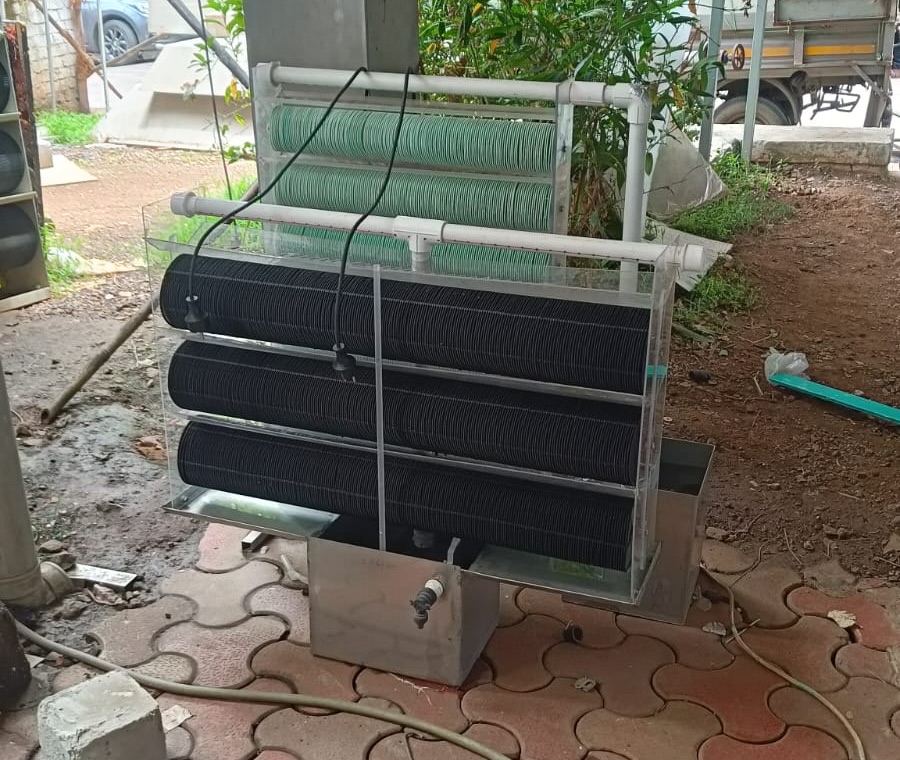
What it means for you
of fan pressure drop per stage, so fans use far less power.
The liquid flow itself turns the disks.
Scrubbing, cooling, humidifying, aerating, stripping and concentrating.
Performance
Packed scrubbers, cooling-tower fill and air washers all force gas through a wetted bed, and pay for it in fan power, flooding, fouling and drift. Textured disks turning slowly through the liquid give a large, constantly renewed contact surface with almost no resistance to gas flow.
Figures are from the research team's field validation in operating conditions. Performance on your stream is confirmed in our laboratory before design.
Challenge and response
Packed scrubbers and fill burn fan power on high pressure drop.
Under 10 Pa per rotor stage keeps fan energy low.
Packing floods at high liquid flow and runs dry at low flow.
Works across a wide liquid-to-gas range, with no flooding or dry spots.
Packing and fill foul or scale, and the plant stops to clean.
Disks are jet-cleaned in place while the unit runs.
Cooling towers and scrubbers lose droplets as drift.
Carryover-free contact between gas and liquid.
How it works
A low-head pump fills the reservoir under the rotors.
The liquid flow itself turns the textured disks; no separate drive motor.
Gas or air sweeps the thin liquid film, exchanging heat and mass.
Online jets keep the disks clean without stopping the unit.
Use cases
Remove CO₂ with water at near-atmospheric pressure.
Clean exhaust gases from kitchens, furnaces and power plants.
Cool with low fan power and no drift, on treated wastewater or seawater.
Condition and clean air for buildings and processes.
Aerate wastewater and strip volatile compounds from groundwater.
Strip gases from liquids and concentrate solutions gently.
Comparison
| Factor | Packed tower / cooling-tower fill | Rispri solution |
|---|---|---|
| Gas-side pressure drop | High, and rises as packing fouls | Under 10 Pa per rotor stage |
| Liquid-to-gas range | Narrow; floods or dries out | Wide, without flooding or poor wetting |
| Drift and carryover | Needs drift eliminators | Carryover-free contact |
| Cleaning | Shutdown to clean or replace packing | Online clean-in-place jets |
| Materials | Fixed packing material | Disks in PP, PC, SS, Al or MS to suit the fluid |
| Scale-up | Custom tower for each duty | Modular rotor units added as needed |
Standards and regulations
We design each system to meet your consent conditions and the regulations for your sector, and our laboratory reports against them.
Industries served
Why Rispri
Built on patented and peer-reviewed research from our partnership with IIT Bombay.
Our accredited laboratory characterises your water or waste before design and verifies results after.
The team that builds ETPs, STPs and ZLD plants across India takes each solution from pilot to full scale.
Design, supply, installation, commissioning, operation and testing under one contract.
Questions
The same rotating-disk platform is configured for gas and biogas scrubbing, cooling towers and evaporative condensers, humidification and air washing, aeration and VOC stripping, and stripping or concentrating liquids. For effluent evaporation, see our ZLD evaporator.
Gas-side pressure drop is under 10 Pa per rotor stage, so fans draw very little power. The pump needs only about 3 m of head, and the liquid flow itself turns the disks, so there is no separate drive motor.
Wastewater vaporisation is at TRL 9 and biogas scrubbing at TRL 8. Cooling towers, seawater vaporisers, evaporative pre-coolers and evaporative condensers are at TRL 7.
Disks are cleaned in place with water jets while the unit runs, and the disk material is chosen for the fluid: PP, PC, stainless steel, aluminium or mild steel.
Yes. It removes CO₂ with water at near-atmospheric pressure, so raw gas does not need compressing before scrubbing. Only the upgraded gas is compressed for Bio-CNG.
Research partnerships
THE NEXT STEP
Send us a sample or tell us about your site. We will test it, recommend a configuration and set up a pilot.
Request a pilot