INDUSTRIES
Industrial wastewater treatment
designed for your industry.
A dairy, a pharma plant and a glass factory can each produce 100 KLD of effluent, and need three completely different plants. These guides explain what each industry's wastewater contains, which rules apply and how it is treated, with testing, treatment, chemicals and training from one team.
In short
Why wastewater differs from one industry to the next.
Industrial wastewater differs by industry because each process loses different materials to the drain. Food, dairy, sugar and distilleries lose organic matter, so their effluent has a high BOD and COD and is treated biologically, often with an anaerobic stage that makes biogas. Pharma, chemical and textile plants add solvents, colour, toxic compounds and salts, so they need segregation, advanced oxidation, RO and often zero liquid discharge (ZLD). Glass, ceramics, engineering and metal plants mostly produce solids, oil and metals, which are removed chemically and physically. In India, every unit must meet the limits in its State Pollution Control Board consent, set from the general standards or one of CPCB's industry-specific standards.
- 25+
- Industry sectors we serve with testing, treatment and chemicals
- 17categories
- Highly polluting industries that must stream outlet data online (OCEMS)
- 1,498+
- Plants and turnkey projects delivered since 1999
- NABL
- Accredited laboratory that tests your effluent before design
Compare sectors
What is in each industry's effluent, and how is it treated?
A quick comparison of the main pollutants, the usual treatment and how often ZLD is required. It is a starting point: your own effluent test decides the design.
| Industry | Main pollutants | Typical treatment | ZLD common? |
|---|---|---|---|
| Dairy | Milk fat, protein, lactose (high BOD/COD); pH swings from CIP cleaning | Fat trap, DAF, equalisation, UASB, aerobic polish | Rare; reuse increasingly expected |
| Food and beverage | Sugar, starch, fats, suspended solids; seasonal peaks | Screening, DAF, anaerobic + aerobic, tertiary | Sometimes |
| Pea and vegetable processing | Starch, soil, blanching water with high BOD; very seasonal | Screening, settling, equalisation, aerobic or anaerobic | Rare |
| Pharmaceuticals and APIs | High COD, solvents, salts, toxic and slowly degraded compounds | Segregation, stripping, oxidation, biology, RO, MEE | Common |
| Chemicals and agrochemicals | High COD and TDS, toxic or non-biodegradable streams | Segregation, neutralisation, advanced oxidation, MEE | Common |
| Textiles and dyeing | Colour, high TDS (salt from dyeing), pH swings, COD | Equalisation, biology, colour removal, RO, evaporation | Common in many clusters |
| Distilleries and ethanol | Spent wash with very high COD, colour and potassium | Biomethanation, evaporation, concentration and incineration or composting | Expected |
| Tanneries and leather | Chromium, sulphide, high salt, protein | Chrome recovery, physico-chemical, biology, RO | Common in some states |
| Pulp and paper | Fibre, COD, colour, lignin | Fibre recovery, clarifier, activated sludge, tertiary | Sometimes |
| Glass | Fine glass solids, alkaline pH, oil, high-TDS blowdown | Coagulation, lamella clarifier, filtration, RO on blowdown | Sometimes |
| Engineering and automobiles | Oil emulsions, spent coolant, metals, phosphate | Demulsification, oil separation, physico-chemical | Sometimes |
| Metal finishing and electroplating | Heavy metals, cyanide, acids | Segregation, cyanide oxidation, chrome reduction, precipitation | Sometimes |
| Hotels, resorts and hospitals | Sewage, kitchen grease, laundry detergents | Grease trap, STP (MBBR, SBR or MBR), reuse | Rare; reuse often required |
Industry guides
Detailed guides for 28 industries.
Each guide covers where the wastewater comes from, typical characteristics, the standards that apply, the treatment scheme, reuse options, indicative costs and common problems.
Dairy and ice cream
Fat separation, CIP acid and caustic neutralisation, whey and biogas.
Dairy guide →Food and beverage
Strong, biodegradable effluent from processing, bottling and confectionery.
Food and beverage guide →Pea processing and freezing
Blanching and washing effluent, seasonal loads and hygiene process water.
Pea processing guide →Pharmaceuticals and APIs
High-COD, solvent-bearing and salty batch effluent, often under ZLD.
Pharma guide →Chemicals and agrochemicals
Toxic and high-TDS streams that need segregation before treatment.
Chemical guide →Textiles and dyeing
Colour removal, high TDS and ZLD for dye houses and processing units.
Textile guide →Glass manufacturing
Fine glass solids, alkaline wash water and cooling blowdown recycling.
Glass guide →Hotels and resorts
Odour-free compact STPs, pool chemistry and soft water for laundry and boilers.
Hotels guide →Automotive and spent coolant
Demulsification, oil separation and sludge handling for machining coolants.
Spent coolant guide →Thermal power plants
Cooling and boiler blowdown, ash water recycling, FGD wastewater and water norms.
Read the guide →Refineries and petrochemicals
Oily water, sour water, phenols and sulphides; API, DAF and biological treatment.
Read the guide →Steel plants
Coke oven effluent, rolling mill scale water and pickling acid neutralisation.
Read the guide →Mines and beneficiation
Mine water, acid drainage, suspended solids and tailings water reuse.
Read the guide →Distilleries and ethanol
Spent wash, biomethanation, evaporation and zero liquid discharge.
Read the guide →Fertiliser plants
Ammonia, urea, nitrate and fluoride removal, and condensate reuse.
Read the guide →Paints and coatings
Pigment and resin wash water, paint sludge and solvent recovery.
Read the guide →Ceramics and tiles
Slurry water recycling, glaze effluent and filter press dewatering.
Read the guide →Cement plants
Water conservation, blowdown reuse, colony STP and zero discharge.
Read the guide →Automobile and engineering
Phosphating, paint shop and plating effluent, oily water and coolant.
Read the guide →Construction sites and RMC
Labour camp STPs, dewatering and ready-mix wash water recycling.
Read the guide →Commercial buildings and airports
STPs, cooling tower water and reuse for malls, IT parks and airports.
Read the guide →Cities and municipal sewage
City STPs, decentralised and nature-based treatment, faecal sludge.
Read the guide →CETPs and industrial estates
Inlet norms, toxic shocks, monitoring and upgrades of common plants.
Read the guide →Rules
Which rules decide how your industry treats wastewater?
Consent under the Water Act, 1974. Every unit that discharges effluent needs a consent to establish (CTE) before building and a consent to operate (CTO) before running, issued by the State Pollution Control Board. The consent lists your outlet limits and where treated water may go. It is the document inspectors check against.
General and industry-specific standards. The Environment (Protection) Rules, 1986 set general discharge standards (for inland surface water, BOD 30 mg/L, COD 250 mg/L, TSS 100 mg/L, pH 5.5 to 9.0) and separate standards for sectors such as dairy, distilleries, sugar, textiles, tanneries, pharmaceuticals, pesticides, pulp and paper, fertilisers, refineries, thermal power and glass. Industry standards may add parameters (colour, specific metals, bio-assay) or set a wastewater volume per tonne of product.
Online monitoring. CPCB requires units in the 17 categories of highly polluting industries, among them distilleries, sugar, pulp and paper, tanneries, pharmaceuticals, dyes, pesticides, fertilisers, refineries, petrochemicals and thermal power, to install online continuous effluent and emission monitoring (OCEMS) linked to the boards.
ZLD conditions. Boards impose zero liquid discharge on many distilleries, textile and dyeing clusters, tanneries, pharma and chemical units, and on plants in water-stressed or sensitive areas.
Groundwater, waste and sewage. Groundwater use needs a no-objection certificate under the CGWA guidelines, 2020. ETP sludge and used oil follow the Hazardous and Other Wastes Rules, 2016. Hospitals follow the Bio-Medical Waste Management Rules, 2016, and sewage plants the limits set by the MoEF&CC and your board.
Treatment
The building blocks of any industrial ETP.
Every industry plant is assembled from the same building blocks. What changes is which ones you need, in what order and at what size. The pollutant decides the block.
| If your effluent has | Typical treatment block | Industries where it is central |
|---|---|---|
| Free oil and fats | Oil and grease trap, DAF; chemical demulsification for emulsions | Dairy, food, engineering, automobiles, oil and gas |
| Suspended solids and fines | Coagulation, flocculation, clarifier or lamella settler, filtration | Glass, ceramics, mining, construction, paper |
| High biodegradable BOD/COD | Anaerobic (UASB) then aerobic (ASP, MBBR, SBR, MBR) | Dairy, food, sugar, distillery, confectionery |
| Toxic or slowly degraded COD | Stream segregation, solvent stripping, Fenton or ozone oxidation, then biology | Pharma, chemicals, pesticides, paint |
| Colour | Biology plus chemical colour removal, ozone or activated carbon | Textiles, distilleries, paper |
| Heavy metals or cyanide | Segregation, cyanide oxidation, chrome reduction, hydroxide or sulphide precipitation | Electroplating, tanneries, steel, mining |
| High TDS (salts) | RO, then evaporator and dryer for the reject | Textiles, pharma, chemicals, tanneries, power plant blowdown |
| Pathogens | Chlorination, UV or ozone after filtration | Hospitals, hotels, sewage, food |
Our NABL-accredited laboratory tests pH, BOD, COD, TSS, TDS, oil and grease, colour and heavy metals on composite samples, and an engineer tells you which blocks your plant needs.
Recovery
What each industry can recover from its wastewater.
Treating effluent only to throw it away is the most expensive option. Most sectors have something worth recovering.
Water
Treated effluent, after filtration and RO, can feed cooling towers, boilers and washing. Concentrated RO reject can be recovered further with our RO reject recovery process.
Energy
Dairy, food, sugar and distillery effluent and organic waste can produce biogas for boilers or Bio-CNG. See waste-to-energy and biogas.
Products
Whey from dairies (whey water recovery), metals from plating and mining water (heavy metal recovery), and salt from ZLD reject (salt recovery and process design).
Where ZLD is required, our non-thermal evaporators evaporate RO reject with air instead of steam, cutting evaporation cost by about 80% compared with a multiple-effect evaporator.
Cost
Why the same flow costs different amounts in different industries.
The cost of an industrial ETP depends more on what is in the water than on how much there is. As a rough guide for a 100 KLD plant:
| Type of effluent | Examples | Usual scheme | Indicative cost at 100 KLD* |
|---|---|---|---|
| Mostly solids and oil | Glass, ceramics, engineering | Physico-chemical with filtration | ₹15 to 40 lakh |
| Moderate organic load | Sewage, hotels, light food units | Biological (MBBR, SBR, ASP) with tertiary | ₹25 to 60 lakh |
| Strong organic load | Dairy, food, confectionery | DAF, anaerobic and aerobic | ₹35 to 80 lakh |
| Toxic, coloured or high-TDS | Pharma, chemicals, textiles | Segregation, oxidation, biology, RO | ₹1 crore upwards |
| Zero liquid discharge | Any of the above under a ZLD consent | ETP, RO, evaporator, dryer | Priced after a water balance |
*Indicative 2026 ranges for equipment, electricals and installation, excluding land, civil works and taxes. We give a firm price only after testing your effluent and seeing the site. For sizing, try our free engineering tools.
We audit existing plants built by anyone, find the stage that fails, and fix it with process changes, retrofits, chemicals tested on your effluent or an O&M contract.
All sectors
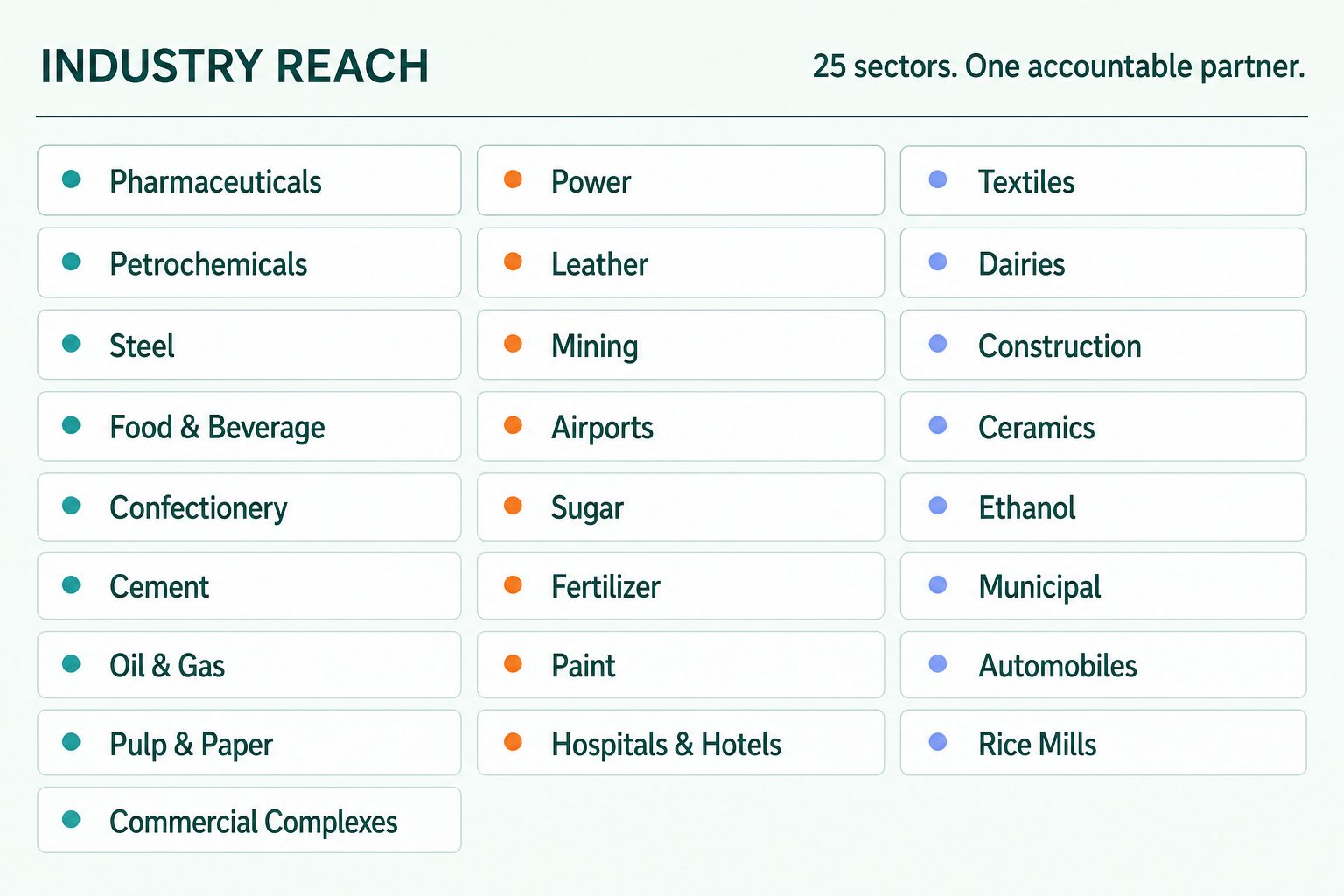
Industries we serve, and the water challenge in each.
Water chemistry, process conditions and compliance pressure change from one sector to the next. Our teams combine chemistry and engineering to shape testing, treatment and operating support around each site, so it uses water efficiently, gets fit-for-purpose water and meets its obligations.
| Sector | Main water challenge |
|---|---|
| Pharmaceuticals | High-COD, solvent-bearing and salty batch effluent; often ZLD |
| Power | Cooling tower and boiler blowdown, DM plant regeneration and ash handling water |
| Textiles | Colour, high salt and pH swings from dyeing and finishing |
| Petrochemicals | Oily water, phenols, sulphides and high COD |
| Leather | Chromium, sulphide and high salt from tanning |
| Dairies | Milk fat, whey and acid and caustic CIP washes |
| Steel | Oil and mill scale from rolling, and phenol, cyanide and ammonia from coke ovens |
| Mining | Suspended solids and, at some mines, acidic or metal-bearing drainage |
| Construction | Silt-laden wash water from batching plants and site sewage |
| Food and beverage | High BOD from sugar, starch and fats; seasonal loads |
| Airports | Large sewage flows, oily runoff from aprons and workshops, and reuse targets |
| Ceramics | Fine clay and glaze slurries that settle slowly |
| Confectionery | Sugar-rich wash water that turns acidic quickly |
| Sugar | Seasonal high-BOD wash water and surplus condensate during crushing |
| Ethanol | Spent wash with very high COD and colour; zero discharge expected |
| Cement | Little process effluent; cooling water, blowdown and dust control |
| Fertiliser | Ammonia, urea and nitrate; fluoride at phosphatic plants |
| Municipal | Sewage treatment, sludge and reuse of treated water |
| Oil and gas | Produced water and oily water with high dissolved salts |
| Paint | Pigment and solvent wash water with high COD |
| Automobiles | Oily water, pre-treatment and paint shop effluent, spent coolant |
| Pulp and paper | Fibre, colour and high COD from pulping and paper machines |
| Hospitals and hotels | Sewage, kitchen grease and laundry water; disinfection for hospitals |
| Rice mills | Parboiling water with high BOD, colour and phenolic compounds |
| Commercial complexes | Sewage treatment and reuse for flushing and gardening |
Quick sector index
Water and compliance
Environmental and pollution control board compliance, water and wastewater testing, ETP, STP, RO and ZLD users, municipal and institutional systems.
Laboratory →Food and hospitality
Hotels, resorts, dairy, ice cream, frozen foods, pea processing, food processing and agri export.
Hotels and resorts →Pharma and formulations
API manufacturing, API intermediates, organic synthesis, excipients including Carbomer 940 and 980, gels, cosmetics, oral care and personal care.
Pharma intermediates →Industrial manufacturing
Glass, textiles, chemicals, agrochemicals, petroleum, lubricants, spent coolant, paper, pulp, sugar, plastics, electronics, construction, mining, boilers and cooling towers.
Glass guide →What we offer
How Rispri supports each industry.
We group our support around what each sector needs day to day: testing, treatment, chemicals, sourcing and training.
Environmental and PCB compliance
NABL-accredited testing of effluent, stack emissions, soil, sludge and noise, with consent and audit reporting.
Our laboratory →ETP, STP and ZLD
Plant design, construction, upgrades, chemical dosing programmes, genuine spares and O&M.
ETP, STP and ZLD plants →Treatment chemicals
Boiler, cooling, RO, effluent and descaling chemicals, plus process chemicals for paper and sugar.
Water treatment chemicals →RO, DM and softening
Process water for electronics, plastics, pharma and boilers, and softeners for laundries and cooling towers.
Water softeners →OCEMS and telemetry
Online analysers, CPCB connectivity and CGWA groundwater telemetry.
Smart water management →Pharma intermediates and excipients
CAS-listed intermediates, bulk APIs and Carbomer 940 and 980 with documentation support.
Pharma intermediates →Buying guide
What to ask any supplier about your industry's effluent.
- Have you treated effluent like mine before? Ask how they handled the specific pollutants in your sector.
- Will you test my effluent first? Composite samples across a full production cycle, in an accredited lab.
- Which streams should be kept separate? Segregation is often the cheapest improvement in pharma, chemical, glass and dairy plants.
- Which standard applies to me? The general standards, an industry-specific standard, or my consent, which may be stricter than both.
- Will I need OCEMS or ZLD? These change the design and the budget.
- What can I recover? Water, biogas, whey, salt or metals.
- What does it cost to run per cubic metre? Power, chemicals, sludge and operators.
- Who operates and tests it after handover? Training, O&M and regular NABL-accredited reports.
Why Rispri
One team for testing, treatment and chemistry.
Our own NABL lab
We test your effluent before design and certify the outlet after start-up.
Engineering since 1999
1,498+ plants and turnkey projects and 499+ clients across industries, hotels, hospitals and cities.
Certified systems
ISO 9001, 14001 and 45001, with offices in Jaipur, Agra and Ahmedabad.
Research collaborations
Proven technologies for RO reject recovery, whey water recovery and non-thermal evaporation, in collaboration with IIT Bombay, IIT Kharagpur and ICT Mumbai.
Questions
Industrial wastewater FAQs.
Why does industrial wastewater differ between industries?
Each process loses different materials to the drain. Food and dairy lose organic matter, pharma and chemical plants lose solvents and salts, and glass or engineering plants lose solids and oil. The pollutants decide the treatment, so plants of the same flow can be very different.
Which industries have their own CPCB effluent standards?
Many do, including dairy, distilleries, sugar, textiles, tanneries, pharmaceuticals, pesticides, pulp and paper, fertilisers, oil refineries, thermal power and glass. Other industries follow the general standards. Your consent to operate sets the final limits.
What are the general discharge standards in India?
For discharge into inland surface water, the general standards under the Environment (Protection) Rules, 1986 include pH 5.5 to 9.0, BOD 30 mg/L, COD 250 mg/L, TSS 100 mg/L and oil and grease 10 mg/L. Limits differ for discharge to a sewer or onto land.
Which industries need zero liquid discharge?
ZLD is commonly imposed on distilleries, textile and dyeing units, tanneries, pharmaceutical and chemical plants, and on units in water-stressed or sensitive areas. Whether it applies to you is written in your consent or a board direction.
What are the 17 categories of highly polluting industries?
They are aluminium smelters, cement, chlor-alkali, copper smelters, distilleries, dyes and dye intermediates, fertilisers, integrated iron and steel, oil refineries, pesticides, petrochemicals, pharmaceuticals, pulp and paper, sugar, tanneries, thermal power plants and zinc smelters. They must run online continuous monitoring (OCEMS) connected to the boards.
Does my industry need an ETP, an STP or both?
An ETP treats process effluent and an STP treats sewage from toilets and canteens. Most factories need both, or a combined plant when sewage is a small share. Hotels, hospitals and commercial complexes usually need only an STP.
How much does an industrial ETP cost?
At 100 KLD, a physico-chemical plant may cost ₹15 to 40 lakh and a biological plant for strong organic effluent ₹35 to 80 lakh, while toxic or high-TDS effluent with RO costs ₹1 crore upwards. These are indicative and exclude civil work and land; we price after testing.
Can industrial wastewater be reused?
Yes. Most treated industrial effluent can be reused for cooling towers, washing and gardening after filtration, and for boilers and process after RO. Reuse is often the cheapest source of water where fresh water is scarce or bought by tanker.
Why should streams be segregated?
Mixing a small toxic or salty stream with a large clean one makes the whole flow hard to treat. Treating strong streams separately, such as whey in dairies, mother liquors in pharma or blowdown in glass plants, usually shrinks and simplifies the main plant.
How do I know what is in my effluent?
Have composite samples, collected over a full production cycle, tested in a NABL-accredited laboratory for pH, BOD, COD, TSS, TDS, oil and grease and sector-specific parameters such as colour or heavy metals. Our lab does this and an engineer explains the results.
Do you work with existing plants built by others?
Yes. We audit, upgrade and operate ETPs and STPs built by other suppliers, supply chemicals and spares, and provide regular test reports for your board.
Do you offer training for plant and laboratory teams?
Yes. We run training on water and wastewater testing, ETP and STP test parameters and good laboratory practice at our NABL-accredited laboratory, and our O&M engineers train operators on the plants we build.
Related