SOLUTIONS / WATER AND WASTE ENGINEERING
Water and wastewater treatment company in India
from the first test to the running plant.
Ram Chemical Enterprises (RCE), the engineering and chemicals arm of Rispri Labs, has designed, built and supplied water treatment plants since 1999. One team tests your water, designs the plant, supplies the chemicals and spares, and keeps it compliant after handover.
In short
Who Rispri and RCE are, and what we do.
Rispri Labs is an Indian water, wastewater and environmental engineering company with its own NABL-accredited laboratory. Its engineering and chemicals arm, Ram Chemical Enterprises (RCE), has worked in water treatment since 1999. We design, supply, install and operate effluent treatment plants (ETP), sewage treatment plants (STP), zero liquid discharge (ZLD) systems, RO, softening, DM and recycling plants, and we make and supply treatment chemicals and genuine spares. Because the laboratory, the engineers and the chemical supply sit in one company, the same team that tests your water is answerable for the plant meeting the limits in your State Pollution Control Board consent.
- 1,498+
- Plants and turnkey projects since 1999
- 499+
- Clients across industry, hospitality and institutions
- 250+
- Products and formulations in eight chemical categories
- 9plant types
- Engineered in house, from softeners to ZLD
Who we are
Why one accountable water partner matters.
Most water problems at a site are linked. Hard borewell water scales the boiler; the boiler blowdown and the softener regeneration add salt to the effluent; the effluent then fails its TDS limit or overloads the RO; and the RO reject has nowhere to go. When the plant comes from one vendor, the chemicals from another and the testing from a third, each one can blame the others and nobody owns the result.
RCE was set up to close that gap. Over more than 26 years it has grown from supplying water treatment chemicals into a full engineering business: treatment plants, components and spares, process design and compliance support. Rispri's NABL-accredited laboratory, with its laboratory and office in Agra, tests the water and effluent that every design is based on, and later certifies that the plant is doing its job.
India's water and wastewater context
India generates far more sewage than it treats. The CPCB's national inventory of sewage treatment plants (2021) put urban sewage generation at about 72,368 MLD (million litres per day), while only around 28% of it was actually being treated. NITI Aayog's Composite Water Management Index has reported that about 600 million Indians face high to extreme water stress. Industry feels this as tighter consents, groundwater permits under the CGWA guidelines, online monitoring of outlets and a steady push to reuse treated water, set out nationally in the National Framework on Safe Reuse of Treated Water (2022).
For a plant owner this means three things. Discharge limits are enforced with real-time data, fresh water keeps getting more expensive or harder to get, and treated water is increasingly treated as a resource rather than waste. Plants that are designed, dosed and tested as one system stay compliant longer and cost less to run.
Key terms used on this page
KLD is kilolitres (1,000 litres) per day; MLD is million litres per day; LPH is litres per hour. BOD and COD measure how much organic pollution water carries. TDS (total dissolved solids) is the salt content. Turnkey means we deliver a complete, working plant and hand over the key.
Solutions directory
What does Rispri build and supply for water and waste?
Each card below explains one service in a sentence or two and links to a full guide with process details, limits and indicative costs.
Effluent treatment plants (ETP)
Physical, chemical and biological treatment of factory effluent to the limits in your consent, with sludge dewatering. MBBR, SBR and MBR options.
ETP guide →Sewage treatment plants (STP)
Compact biological plants for housing societies, hotels, hospitals, institutions and factory townships, with treated water reused for flushing and gardening.
STP guide →Zero liquid discharge (ZLD)
Pre-treatment, UF, RO, evaporator and crystalliser stages so no liquid leaves the site and most of the water returns to the process.
ZLD guide →Non-thermal evaporators
Our RCD vaporiser evaporates RO reject and high-TDS streams with air instead of steam, at roughly 80% lower evaporation cost than a steam MEE.
Evaporator guide →Water treatment plants, RO and softeners
RO plants from 500 LPH to multi-MLD, softeners, sand and carbon filters, DM plants and recycling systems for process, boiler and drinking water.
Plant types on this page →Water treatment chemicals
Cooling, boiler, descaling, effluent, RO, paper, sugar and pool chemicals, chosen with jar tests on your own water.
Chemicals guide →Components and spares
Membranes, FRP vessels, resins, media, cartridges, valves, blowers, filter presses and instruments from recognised manufacturers.
Spares list →OCEMS and smart water management
Online effluent analysers, CGWA flow meters and piezometers with telemetry, data loggers and CPCB connectivity.
Monitoring guide →Waste management
Segregation, composting and handling systems for solid waste under the Solid Waste Management Rules, 2016, and help with hazardous waste records.
Waste guide →Waste-to-energy and Bio-CNG
Anaerobic digesters, biogas scrubbing and compressed biogas (CBG / Bio-CNG) plants that turn high-COD organic waste into fuel.
Waste-to-energy guide →Seawater desalination
Seawater and brackish water RO with isobaric energy recovery devices and duplex stainless steel skids for coastal sites and island resorts.
Desalination guide →EPC and O&M projects
Single-point engineering, procurement, construction and commissioning, and long-term operation and maintenance contracts.
EPC guide →Pond and lake rejuvenation
Desilting, aeration, natural treatment and inflow control to bring polluted ponds and lakes back to life.
Pond guide →Process design and circularity
Mass and water balances, salt and resource recovery, DPRs and feasibility studies before you spend on hardware.
Process design guide →Water and wastewater testing
NABL-accredited tests for design, consent applications and monthly compliance reports.
Testing guide →Send us a sample. Our NABL-accredited laboratory tests your raw water or effluent, and an engineer explains which treatment stages, chemicals or permits apply to your site.
How a project runs
How a water treatment project runs with Rispri.
Whether it is a 1,000 LPH softener or a large ZLD plant, the steps are the same. Smaller jobs move through them in days; larger ones in months.
- 1
Understand
Site visit, water and wastewater sampling, flow measurement, and a read of your consent and CGWA conditions.
- 2
Test
Composite samples analysed in our NABL lab; jar tests and treatability trials where needed.
- 3
Design
Mass and water balance, process flowsheet, P&ID, reactor and hydraulic sizing, layout and running-cost estimate.
- 4
Build
Fabrication, civil and mechanical works, electrical panels, piping and instruments.
- 5
Commission
Start-up, biology seeding, performance run, lab-certified outlet results and operator training.
- 6
Operate
O&M or AMC, chemicals and spares, monthly test reports and help with board filings.
| Goal | What we do |
|---|---|
| Design the treatment train | Mass and water balance calculations; P&ID and hydraulic retention sizing; biological and chemical reactor sizing; CAD layouts and flowsheet schematics |
| Optimise recovery | ZLD modelling; chemical dosage and jar test optimisation; RO membrane antiscalant advice; energy and water audit reports |
| Plan the approvals | Groundwater NOC from CGWA; consent to establish and operate (CTE/CTO); OCEMS real-time data verification; hazardous waste filings such as annual returns |
| Test the investment | DPR and feasibility simulation; on-site start-up and performance run; third-party independent audit review; operator training programmes |
| Connect the environmental plan | Baseline environmental review; water and wastewater impact assessment; mitigation and monitoring plans; inputs to environmental clearance documents |
Engagement models: hourly consultation, project-based process design, or a retainer for annual compliance support.
Plant types
Which water treatment plant do you need?
The right plant depends on what is in the water and what you need it for. This table compares the plants we manufacture and when each one makes sense.
| Plant | What it does | Best for | Our build | Watch-outs |
|---|---|---|---|---|
| Reverse osmosis (RO) | Pushes water through a membrane that holds back up to 99% of dissolved salts | High-TDS borewell water, process and drinking water, reuse | 500 LPH to multi-MLD; multi-stage; Hydranautics / FilmTec membranes; auto-flush and CIP provisions; remote monitoring | Needs good pre-treatment and antiscalant; produces a reject stream that must be managed |
| Water softener | Ion-exchange resin swaps calcium and magnesium (hardness) for sodium | Boiler feed, cooling tower make-up, laundries, hotels | Simplex and duplex; automatic or manual regeneration; Fleck valve controls | Does not reduce TDS; brine from regeneration adds salt to effluent |
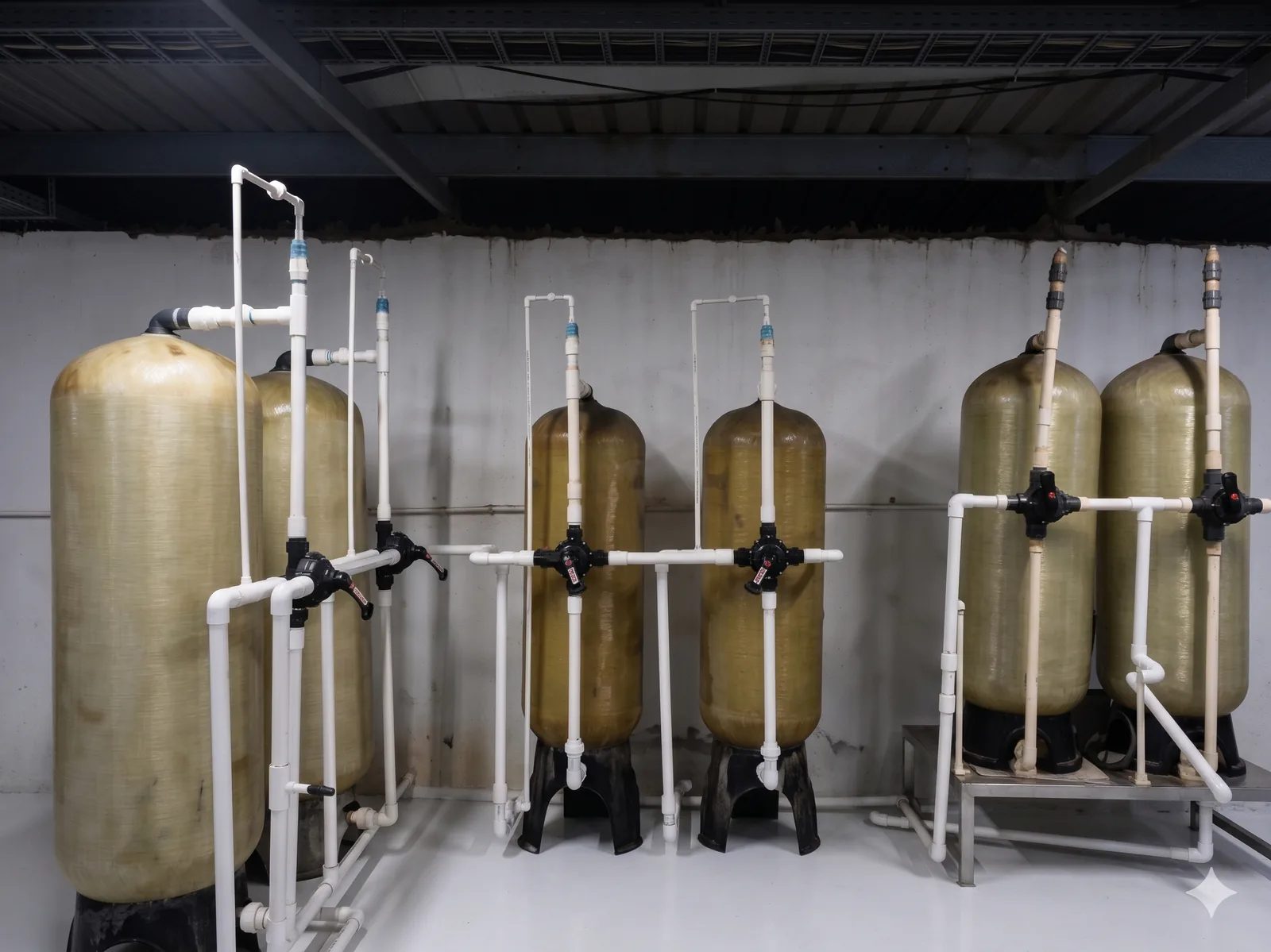
| Filtration (sand, carbon, dual media) | Removes turbidity, iron, chlorine, odour and some organics | Groundwater and surface water; pre-treatment for RO and ion exchange | FRP or MS vessels; manual or automatic backwash; multiport or butterfly valve control; GAC media | Needs regular backwash; carbon must be replaced when exhausted |
| DM (demineralisation) | Cation and anion resins remove almost all dissolved ions | High-pressure boilers, power, pharma, laboratories, precision manufacturing | Two-bed, mixed-bed and EDI; strong acid / strong base resins; conductivity as low as 0.1 µS/cm; online conductivity monitoring | Acid and alkali handling for regeneration; often placed after RO to cut chemical use |
| Water recycling | Tertiary treatment, UF and RO on treated effluent or process water | Plants short of water or under reuse or ZLD conditions | UF + RO recycle trains; recovery of 85 to 95%; ZLD support | Recovery depends on feed chemistry; reject needs a plan |
| ETP | Removes BOD, COD, TSS, colour and heavy metals from industrial effluent | Any unit discharging process wastewater | Physical, chemical and biological stages; MBBR, SBR, MBR; sludge dewatering | Must be sized on tested effluent, not textbook values |
| STP | Biological treatment of domestic sewage | Housing, hotels, institutions, municipalities, factory townships | MBBR, SBR, MBR; compact designs for tight sites; reuse for flushing, gardening, cooling towers | Shock loads at weekends and festivals; odour if under-aerated |
| ZLD | Recovers water and turns the reject into dry salt or cake | Textiles, tanneries, pharma, dyes and others under ZLD consent | 5 to 500 KLD; pre-treatment, UF, RO, MEE, MVR and crystalliser; PLC / SCADA with remote monitoring; up to 100% water recovery | High energy if steam-based; MVR can cut steam use by up to 70% |
| Seawater RO (SWRO) | Desalinates seawater and brackish water | Coastal industry and island resorts | TDS reduction up to 99.8%; isobaric energy recovery devices; high-pressure duplex skids | Intake, outfall and brine disposal need approvals |
We also build swimming pool plants (sand filtration and UV, automatic pH and chlorine dosing, pumps, skimmers and accessories) and waste-to-energy plants (Bio-CNG refineries, anaerobic biomethanation digesters, methane scrubbers and power generation). Images on our product pages are representational only.
The Rispri electromagnetic water softener uses a controlled electromagnetic field to stop hardness minerals sticking to pipes and surfaces. It is chemical-free, needs no salt or regeneration, and comes with a 2-year warranty.
Chemicals
Water treatment chemicals in eight categories.
RCE began as a chemicals supplier, and chemistry is still at the heart of the business. Our range is non-polluting and designed for simple, continuous dosing, manual or automatic, and is supplied in tamper-proof packaging.
| Category | What it solves | Typical products | Used in |
|---|---|---|---|
| Cooling water | Corrosion, scale and biological fouling in cooling circuits | Corrosion and scale inhibitors for open and closed circuits; biocides; dispersants; pH stabilisers and conductivity control | Cooling towers, heat exchangers, condensers, chillers, HVAC, power plants |
| Boiler water | Scale, oxygen corrosion and carry-over | Oxygen scavengers; scale and deposit inhibitors; alkalinity and pH control; anti-foam and anti-carry-over treatments. For low, medium and high pressure boilers; FSSAI-compatible grades for food process steam | Fire-tube and water-tube boilers, steam generators, heat recovery, captive power |
| Descaling | Hard mineral, iron oxide and silica deposits | Inhibited acid blends; non-acid and non-corrosive options; liquid and powder forms for rinse-through or soak cleaning; biodegradable options | Boilers, RO membranes, heat exchangers, pipelines, cooling towers, condensers |
| Effluent treatment | BOD, COD, TSS and colour in ETP and STP | Poly aluminium chloride (PAC) and alum; anionic, cationic and non-ionic polyelectrolytes; acid and alkali for pH; odour control and disinfection; sludge dewatering aids | Industrial ETPs, municipal STPs, textile, food, paper and chemical plants |
| RO chemicals | Membrane scaling, biofilm and loss of flux | Antiscalants for carbonate, sulphate and silica; non-oxidising biocides; acid and alkaline CIP cleaners; dechlorinators. Compatible with Hydranautics, FilmTec and Toray membranes; NSF-grade options for potable water | RO, NF and UF plants, drinking water, brine concentration, pharma, food |
| Paper process | Pitch, stickies, drainage and deposits | Retention and drainage aids; pitch and stickies control; felt and wire cleaners; deposit control and scale inhibitors | Paper and board mills, tissue, recycled fibre, white water systems |
| Sugar processing | Juice clarity and evaporator scale | Juice clarification flocculants for mud settling; scale inhibitors for evaporators and vacuum pans; condenser cooling water treatment; ETP chemicals; seasonal dosing protocols | Cane and beet sugar mills, refineries, barometric condensers |
| Swimming pool | Hygiene, clarity and bather comfort | Chlorine-based and non-chlorine disinfectants; pH adjusters (acid and soda ash); algaecides and clarifiers; scale and stain prevention; dosing and testing support | Hotel and club pools, water parks, public pools, spas, sports centres |
Full product details are on our water treatment chemicals page. We recommend doses after jar tests on your own water, not from a generic chart.
Components and spares
Genuine parts from our catalogue.
We supply membranes, media, vessels, valves, instruments and mechanical equipment from recognised manufacturers, held in our warehouse so plants are not left waiting.
| Group | Items and sizes |
|---|---|
| Filtration | MS and FRP pressure filter housings and 20" bag filter vessels; Big Blue housings in 10" and 20"; side-mount sand filters for pools, hotels and water parks |
| Cartridges | Polypropylene spun cartridges 2.5×20, 4×20 and 4.5×20 inch; string-wound (thread) depth cartridges |
| Media | Granular activated carbon; ion-exchange resins (softener resin 220Na, DM cation resin 225H, DM anion resin NIP, mixed bed resin FFIP); polyethylene MBBR media; PVC tube settler media |
| FRP pressure vessels | 1030, 1042, 1054, 1248, 1648, 1672, 2472, 3072, 3672, 4072 |
| RO membranes | 4040 and 4080 spiral-wound elements (Hydranautics / FilmTec); 4" housings 4040, 4080, 40120, 40160; 8" housings 8040, 8080, 80120, 80160; end caps, adapters and interconnectors |
| Valves and controls | 6-position top and side mount multiport valves; automatic air release valves 1" and 1.5"; under-drain lateral distribution systems Type A and B; single and three-phase MCC panels with DOL and auto-manual switching |
| Instruments | Electromagnetic flow meters, online and offline, 1" to 6"; standpipe piezometers; Bourdon tube pressure gauges; online pH, TDS and conductivity analysers |
| Mechanical | Roots-type lobe air blowers (single and three phase); plate-and-frame filter presses; gasketed plate heat exchangers |
See the full product catalogue, or ask for an equipment quote through the form below.
Standards
The rules every design is checked against.
Every plant, product and report we prepare is checked against the rules your auditors and board inspectors use.
| Rule or standard | What it covers |
|---|---|
| Water (Prevention and Control of Pollution) Act, 1974 | Consent to establish and consent to operate from the SPCB for any unit that discharges wastewater |
| Environment (Protection) Rules, 1986 | General discharge standards (Schedule VI) and industry-specific standards that ETPs are designed to meet |
| MoEF&CC STP notification, 2017 and NGT orders | Treated sewage quality for STPs; some states set tighter limits |
| IS 10500:2012 | Drinking water limits we use for potable RO, filtration and softening systems |
| IS 14543:2016 | Packaged drinking water requirements for bottling plants |
| CPCB OCEMS directions | Online continuous effluent and emission monitoring for the 17 categories of highly polluting industries |
| CGWA guidelines, 2020 | Groundwater NOC, tamper-proof flow meters, piezometers and telemetry for sites that draw groundwater |
| Hazardous and Other Wastes Rules, 2016 | Authorisation, storage, manifests and annual returns for ETP sludge and other hazardous waste |
| National Framework on Safe Reuse of Treated Water, 2022 | How states plan and price the reuse of treated wastewater |
Cost
How much does a water treatment plant cost?
Price depends on what is in the water, how clean it must be, and how the job is bought: equipment only, or a complete turnkey plant. These ranges are for early budgeting only.
| Plant | Typical size | Indicative cost* |
|---|---|---|
| Industrial RO plant | 1,000 LPH, borewell water up to about 2,000 mg/L TDS | ₹3 to 7 lakh |
| Ion-exchange softener | 1 to 5 m³/h for boiler or hotel use | ₹1 to 5 lakh |
| Packaged STP | 50 KLD | ₹12 to 30 lakh |
| Biological ETP | 100 KLD | ₹25 to 60 lakh |
| ZLD system | 50 to 100 KLD | ₹1.5 crore upwards |
*Indicative 2026 ranges for equipment, electricals and installation, excluding land, civil works, taxes and freight. Actual prices depend on water quality, materials of construction, automation and site conditions. We give a firm price only after testing your water and seeing the site.
Equipment supply
You buy the plant or skid; your team or contractor installs it. Lowest upfront price, but you carry the risk that the pieces work together.
Turnkey (design and build)
We design, supply, install and commission, and guarantee outlet quality. Higher price, one point of responsibility. See EPC and O&M.
Running cost
Power, chemicals, membranes and media, sludge disposal, operators and lab tests. We calculate it per cubic metre for each design so you can compare options fairly.
We audit existing ETPs, STPs and RO plants, retune dosing and aeration, replace worn spares and take over O&M, including plants built by others.
Where projects go wrong
Common water project problems, and how we prevent them.
- 01The problem
Plant, chemicals and testing come from three vendors and nobody owns the result.
What we doOne team designs the plant, supplies the chemistry and checks the outcome in our own accredited laboratory.
- 02The problem
Discharge limits tighten and online monitors report every breach.
What we doDesign to CPCB and SPCB limits with a safety margin, and build outlets ready for OCEMS analysers.
- 03The problem
Fresh water is expensive, rationed or needs a groundwater permit.
What we doCost reuse loops, RO and ZLD early, so the water saved helps pay for the plant.
- 04The problem
RO membranes foul and need replacing every year.
What we doFix pre-treatment, choose the right antiscalant for the feed chemistry and set up a cleaning schedule based on pressure and flow trends.
- 05The problem
Spares, service and chemicals slow down after handover.
What we doGenuine parts and dosing chemicals from our own warehouse, with O&M and AMC support from the same supplier.
Industries
Industries we serve.
Each sector uses water differently and produces a different effluent. These guides explain what that means for treatment.
Dairy plants
Milk fat, whey and CIP washes; softeners and boiler chemicals for steam.
Dairy guide →Glass manufacturing
Cooling water chemistry, grinding effluent and solids recovery.
Glass guide →Food and pea processing
Strong, biodegradable effluent suited to anaerobic treatment and biogas.
Pea processing guide →Metalworking and spent coolant
Oily emulsions that must be broken before biological treatment.
Coolant guide →Pharmaceuticals
High-COD, high-TDS batch effluent, DM water and frequent ZLD conditions.
Pharma guide →See all industries, including textiles, chemicals and food and beverage.
Buying guide
How to choose a water treatment engineering partner.
Ask these questions of any company, including us.
- Will you test my water before you quote? A design based on assumed values is a guess.
- What outlet or product water quality do you guarantee? In writing, against my consent or IS 10500 limits.
- What will it cost to run per cubic metre? Power, chemicals, membranes and labour, with the calculation.
- Who supplies chemicals and spares later? And how fast can they reach my site?
- Is it equipment supply or turnkey? Know exactly who is responsible for civil works, piping, electricals and start-up.
- Who operates it after handover? Training, O&M or AMC, and what the response time is.
- Can you help with consents, CGWA and OCEMS? The plant is only half of compliance.
- Can I see similar plants you have built? Ask for references in your sector and size range.
Why Rispri
The Ram Chemical advantage.
Lab and engineering together
Our NABL-accredited laboratory tests your water before design and verifies results after start-up. No hand-offs between vendors.
26+ years in the field
1,498+ plants and turnkey projects since 1999, from compact STPs to industrial ETP, RO and ZLD systems.
Chemicals and spares in stock
250+ products, tamper-proof packaging and an organised warehouse, with a supply network from Agra across India.
Clear scope, ISO systems
Transparent pricing and honest scope, under ISO 9001, ISO 14001 and ISO 45001 management systems, with products checked before dispatch.
Questions
Water and wastewater engineering FAQs.
What is Ram Chemical Enterprises?
Ram Chemical Enterprises (RCE) is the engineering and chemicals arm of Rispri Labs. Since 1999 it has designed and built water and wastewater treatment plants and supplied treatment chemicals and spares, backed by Rispri's NABL-accredited laboratory.
What does a water and wastewater treatment company do?
It tests water and effluent, designs treatment plants, builds and commissions them, and often operates them. A full-service company also supplies the chemicals and spares the plant needs and helps with pollution control board consents and monitoring.
Should I buy equipment only or a turnkey plant?
Equipment supply is cheaper upfront and suits sites with their own engineering team. A turnkey plant costs more but gives you one party responsible for design, installation and guaranteed outlet quality, which matters when your consent is at stake.
How do I choose a water treatment plant manufacturer?
Choose one that tests your water before designing, guarantees outlet quality in writing, shows its running-cost calculation and can support chemicals, spares and O&M after handover. Ask to see similar plants in your sector.
What is the difference between O&M and AMC?
An O&M (operation and maintenance) contract means the contractor runs the plant day to day with its own operators and is responsible for performance. An AMC (annual maintenance contract) covers scheduled servicing and breakdown visits, while your own staff operate the plant. A comprehensive AMC also includes spares.
Do you take over plants built by other companies?
Yes. We audit the plant, test every stage in our laboratory, fix design or operating faults and then run it under an O&M contract or AMC if you want.
Which water treatment plant do I need for hard borewell water?
If the problem is only hardness, a softener is enough. If TDS is also high, you need an RO plant, usually with sand and carbon pre-filters. A water test tells you which, and costs far less than buying the wrong plant.
Is an ETP or STP mandatory?
Any unit that discharges wastewater needs consent from its State Pollution Control Board under the Water Act, 1974, and the consent sets treatment limits. Many states also require STPs in larger housing projects, hotels and institutions as a condition of their approvals.
Can treated wastewater be reused?
Yes. Treated sewage is widely reused for flushing, gardening and cooling towers, and treated effluent with UF and RO can feed boilers and processes. Our recycling plants recover 85 to 95% of the water, depending on its chemistry.
What help do you give with compliance?
We help with consent to establish and operate applications, CGWA groundwater NOCs, OCEMS data verification and hazardous waste filings, and provide NABL-accredited test reports for submission to the board.
Do you supply chemicals and spares for any brand of plant?
Yes. Our chemicals are matched to your water through jar tests, and our spares range covers standard membranes, FRP vessels, resins, cartridges, valves, blowers and instruments that fit most plants.
Where does Rispri work?
Our head office is in Jaipur, our laboratory and office in Agra and another office in Ahmedabad. We deliver plants and supply chemicals across India, and take on EPC projects abroad.
Related