SOLUTIONS / WATER SOFTENERS
Water softeners for home and industry
so hard water stops costing you.
Hard water leaves scale in geysers, taps, pipes and boilers. We supply the salt-free Rispri electromagnetic water conditioner for homes and buildings, and automatic ion-exchange softening plants for boilers, cooling towers and process water, sized from a test of your own water.
In short
What a water softener does.
A water softener is a device that removes hardness, the dissolved calcium and magnesium that cause scale, from water. Most softeners work by ion exchange: water flows through a bed of resin beads that hold on to calcium and magnesium and release sodium in their place. When the resin is full, it is regenerated with common salt brine and rinsed. Softeners are used for bathrooms and whole houses, hotels, laundries and, above all, boiler feed and cooling tower make-up. Under BIS IS 10500:2012, drinking water should ideally have total hardness below 200 mg/L as CaCO₃, with 600 mg/L permissible where no other source exists.
A salt-free water conditioner, such as the Rispri electromagnetic unit, works differently: it leaves the minerals in the water and is designed to reduce how strongly they stick to surfaces as scale.
- 200mg/L
- Acceptable total hardness in drinking water, IS 10500
- 600mg/L
- Permissible limit when no other source exists
- 5%
- Extra boiler fuel for every 1 mm of scale on heating surfaces
- 15,259
- Groundwater locations tested by CGWB in its 2024 quality report
The basics
What is hard water, and why does it matter?
Hard water is water with a high content of dissolved calcium and magnesium. Rain picks these up as it soaks through limestone, chalk and other rock, so borewell water in much of Rajasthan, Gujarat, Haryana, Uttar Pradesh and the Deccan is often hard, sometimes very hard.
Hardness is reported in mg/L as CaCO₃: all the calcium and magnesium expressed as if it were calcium carbonate, so different waters can be compared on one scale. Some softener makers use grains per gallon (gpg): 1 gpg equals 17.1 mg/L as CaCO₃. A widely used scale calls water soft below 60 mg/L, moderately hard at 61 to 120, hard at 121 to 180 and very hard above 180 mg/L.
Signs you have hard water
- White, chalky crust on taps, shower heads and tiles that comes back days after cleaning.
- Geysers that take longer to heat, make crackling noises or need element replacement often.
- Soap and shampoo that will not lather; a sticky film on skin and dull, dry hair.
- Spots on glasses and utensils; stiff, greying laundry.
- Narrowed pipes and lower flow from fittings over the years.
- In industry: scale in boilers, heat exchangers, cooling towers and RO membranes, and rising fuel and maintenance bills.
Temporary and permanent hardness
Temporary (carbonate) hardness is the part linked to bicarbonate. Heating drives it out as calcium carbonate scale, which is why kettles, geysers and boilers suffer first. Permanent (non-carbonate) hardness is linked to sulphate and chloride; it stays dissolved on boiling but still forms scale when water evaporates or is concentrated, for example in a cooling tower. An ion-exchange softener removes both.
Hardness is not a health hazard at the levels found in most supplies; the limits in IS 10500 are mainly about taste, scale and soap use. The cost of hard water is in energy, appliances and maintenance.
How it works
How an ion-exchange water softener works, step by step.
A softener is a pressure vessel filled with resin beads, a brine tank and a control valve. The valve runs the cycle below automatically, by timer or by the volume of water used.
| Step | What happens | Why it matters |
|---|---|---|
| 1. Service | Hard water flows down through strong acid cation (SAC) resin in sodium form. Calcium and magnesium are captured; sodium is released. Soft water flows out. | Outlet hardness is close to zero until the resin is nearly used up. |
| 2. Backwash | Water flows upward to lift and loosen the bed and wash out trapped dirt. | Prevents channelling and pressure build-up. |
| 3. Brining | Salt solution (brine) is drawn slowly through the resin. The high sodium concentration pushes calcium and magnesium off the beads. | Restores the resin's capacity. Salt dose decides how much capacity you get back. |
| 4. Slow rinse | Brine is pushed through at a slow rate so it has time to work, then displaced. | Completes regeneration. |
| 5. Fast rinse | Fresh water rinses out the remaining brine. | Stops salty water reaching your taps or boiler. |
| 6. Brine refill | The valve refills the brine tank to dissolve salt for the next cycle. | Ready for the next regeneration. |
Regeneration water carries the removed hardness and leftover salt. It usually goes to drain; in a factory it should be routed to the ETP and counted in its TDS load.
Softener, RO or conditioner: which one solves your problem?
| Option | What it does | Best for | Watch-outs |
|---|---|---|---|
| Ion-exchange softener | Removes calcium and magnesium; swaps them for sodium | Boilers, cooling make-up, laundries, whole-house and bathroom water | Needs salt and regeneration water; does not lower TDS |
| Reverse osmosis (RO) | Removes most dissolved salts, hardness included | Drinking water, high-TDS water, high-pressure boilers | Rejects a share of the feed as concentrate; needs pre-treatment |
| Rispri electromagnetic conditioner | Keeps minerals in the water; designed to reduce how they stick as scale | Homes, apartments, hotels and buildings that want no salt, no chemicals and no wastewater | Does not lower measured hardness; not a substitute for a softener where zero hardness is required, such as boiler feed |
| Polyphosphate dosing | Small dose that holds hardness in solution | Small circuits at low temperature | Consumable; not for hot water above its working range |
Our NABL-accredited laboratory measures total, calcium and magnesium hardness, alkalinity, TDS and iron, so the product is chosen for your water and not for an average.
Product range
Our water softeners and conditioners.
From a single home to high-demand commercial and industrial systems. Choose by what you need: zero hardness for a boiler, softened water for a whole building, or salt-free scale control.
Rispri electromagnetic water conditioner
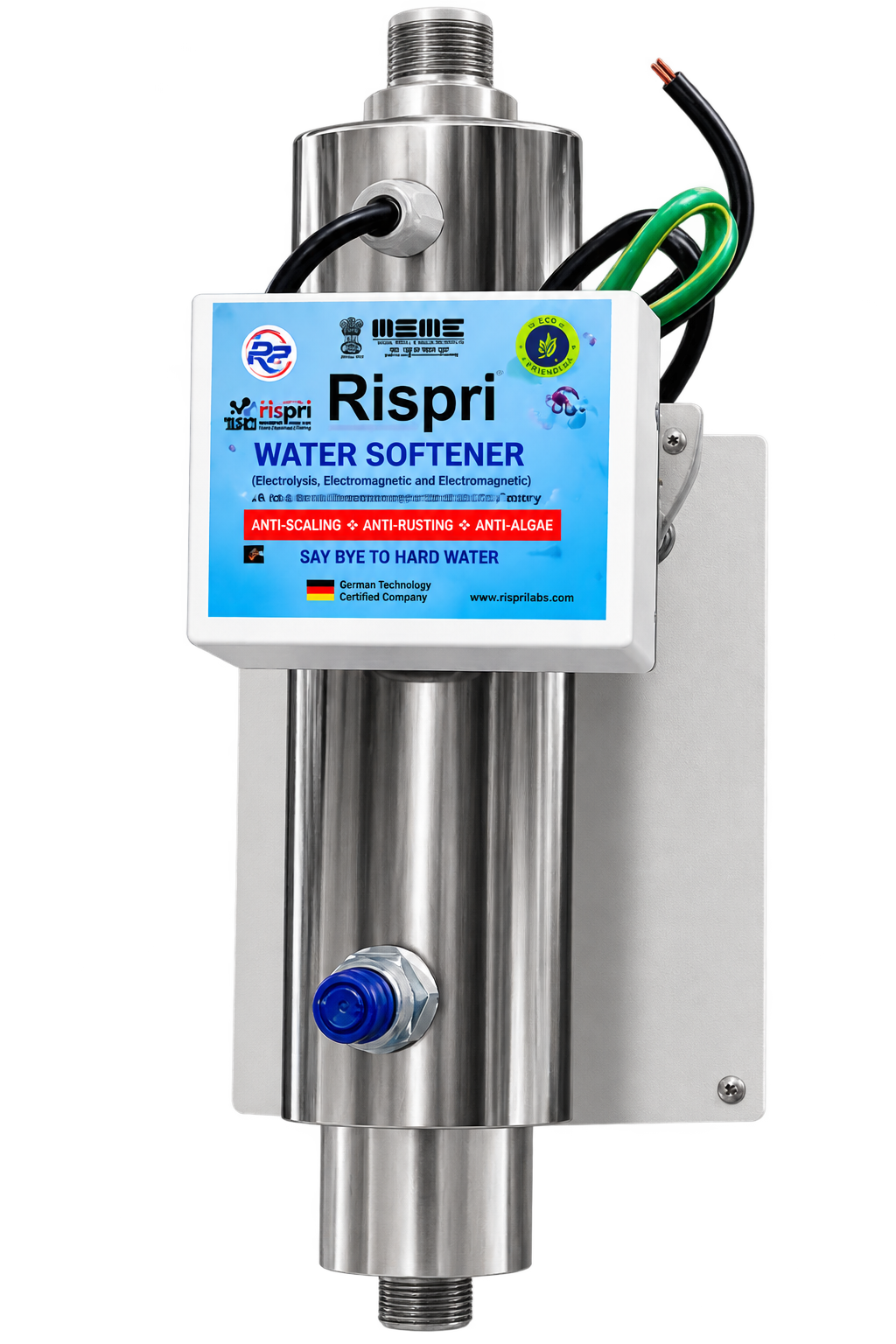
The Rispri Water Conditioner is a compact, chemical-free unit that conditions hard water in-line. It fits around the existing pipe, so there is no pipe cutting and the water supply continues during installation. There are no regeneration cycles, no salt, no resin and no chemical dosing, and no regeneration wastewater.
The electromagnetic field is designed to influence how hardness minerals behave in water, reducing their tendency to adhere to pipes, fixtures and heat-transfer surfaces. Deposits that do form are softer and easier to flush away. The natural mineral profile of the water is retained. It is offered as anti-scaling, anti-rust and anti-algae protection for domestic and industrial use.
Where it is installed: water source (borewell or supply) → pump → Rispri conditioner → storage tank or distribution → end use across your system.
Where it fits: homes, apartments and hospitality; hospitals, commercial facilities and utilities; cooling, boiler and process environments; scalable configurations for larger lines.
Ion-exchange softening plants for industry and buildings
| Product | What it is | Best for |
|---|---|---|
| Industrial automatic water softening plants | Automatic multi-port valve softening skids for uninterrupted soft water delivery; Fleck valve-based controls; auto or manual regeneration | Hotels, hospitals, laundries, process water, cooling tower make-up |
| High-capacity cation exchange resin beds | Strong acid cation (SAC) resin beds for complete capture of hardness ions (Ca²⁺ and Mg²⁺) | Larger flows and very hard borewell water |
| Boiler feedwater hardness elimination units | Zero-hardness feed water supply that protects boilers and cooling loops from scaling | Steam boilers, thermic and hot water systems |
| Duplex and triplex continuous flow softeners | Twin or triple alternating resin tanks: one regenerates while the other serves, for 24/7 operation | Process plants and boilers that cannot stop for regeneration |
Softeners are built in simplex and duplex configurations on FRP pressure vessels (common sizes 1030, 1042, 1054, 1248, 1648, 1672, 2472, 3072, 3672 and 4072, where the first digits are diameter and the last are height in inches), with 220Na softener resin. Resin, valves and vessels are also sold as spares.
Which one should you buy?
| Your need | Our suggestion |
|---|---|
| Scale on taps and geyser in a flat or villa; no space or wish for salt | Rispri conditioner, 1 or 1.25 to 1.5 inch, on the main line after the pump |
| Bathroom or whole-house soft water for skin, hair and fittings | Automatic ion-exchange softener on the line feeding bathrooms or the overhead tank |
| Hotel, hospital or apartment block | Automatic softening plant for hot water and laundry; conditioner on large distribution lines |
| Steam boiler | Boiler feedwater hardness elimination unit, duplex if the boiler runs round the clock, plus boiler chemicals |
| Cooling tower make-up | Softening plant to allow higher cycles of concentration, with cooling chemicals |
| Hard and high-TDS water for drinking | Softener ahead of an RO plant, or RO alone, after a water test |
Sizing
How to size a water softener.
A softener is sized on the amount of hardness it must remove between regenerations, not just on flow. You need three numbers: hardness, water use and how often you are willing to regenerate.
- 1
Measure hardness
Total hardness in mg/L as CaCO₃, from a lab test. Add iron and manganese if present.
- 2
Estimate daily water use
Litres per day for the softened line, and the peak flow in litres per minute or m³/h.
- 3
Work out the load
Hardness (mg/L) × water (litres) ÷ 1,000 = grams of hardness per day.
- 4
Pick resin volume
Resin volume = load between regenerations ÷ resin operating capacity, then check the vessel suits your peak flow.
As a working figure, SAC softener resin delivers an operating capacity of roughly 45 to 55 g of hardness (as CaCO₃) per litre of resin when regenerated with about 100 to 150 g of salt per litre of resin. More salt gives a little more capacity but wastes more salt.
| Example | Inputs | Working | Result |
|---|---|---|---|
| Home, four people | Hardness 400 mg/L; 600 L/day to bathrooms and kitchen | 400 × 600 ÷ 1,000 = 240 g/day. A 25 L resin bed at 45 g/L holds about 1,125 g | Regenerate about every 4 days; about 3 kg salt per regeneration, roughly 20 to 25 kg a month |
| 2 t/h steam boiler | Hardness 300 mg/L; 40 m³/day feed water | 300 × 40,000 ÷ 1,000 = 12,000 g/day. For one regeneration a day: 12,000 ÷ 45 ≈ 270 L resin | Duplex softener with about 300 L resin per vessel; about 35 to 45 kg salt per regeneration |
Worked examples are indicative. Real sizing also checks service flow rate per litre of resin, pressure drop, iron content and a safety margin. Try our free water softener sizing calculator and water hardness calculator, then ask us to confirm.
Installation and maintenance
Installation
- Softener after the pump and any sediment or iron filter, before the geyser or boiler
- A bypass valve for servicing
- A drain point and power socket for the control valve
- Conditioner: clamps around the existing pipe, no cutting
Routine checks
- Keep the brine tank at least a quarter full of salt
- Test outlet hardness weekly at home, daily for boilers
- Reset the timer after power cuts
- Check the bypass is closed after any service
Periodic service
- Clean the brine tank and injector once or twice a year
- Check valve seals and pistons
- Resin clean-out where iron is present
- Resin replacement when capacity has clearly fallen
Limits
Hardness limits and the standards behind them.
Which limit applies depends on what the water is used for.
| Use | Hardness guidance | Source |
|---|---|---|
| Drinking water | Total hardness 200 mg/L acceptable; 600 mg/L permissible in the absence of an alternate source | BIS IS 10500:2012 |
| Low and medium pressure boiler feed | Practically zero hardness; exact values per boiler maker | IS 10392, Indian Boiler Regulations, boiler manual |
| Cooling tower make-up | Set by the cycles of concentration you want and the scaling index | Treatment programme (LSI/RSI) |
| Heat transfer surfaces | Each 1 mm of scale adds about 5% to fuel use | Bureau of Energy Efficiency guidance |
| Testing | Hardness and TDS before installation, and outlet checks after | NABL-accredited laboratory |
Cost
What does a water softener cost to own?
The purchase price is only part of it. Salt, regeneration water, power for the valve and service add up over the years, while scale damage you avoid pays it back.
| Item | Ion-exchange softener | Rispri conditioner |
|---|---|---|
| Equipment | Depends on resin volume, valve and vessel; rises with hardness and flow | Depends on pipe size, 1 inch up to custom above 4 inch |
| Salt | About 100 to 150 g per litre of resin per regeneration (see examples above) | None |
| Water | Backwash, brine and rinse water every regeneration | None |
| Service | Annual valve and brine tank service; resin replacement after several years | None routinely; 2-year replacement warranty |
| Result | Hardness removed; outlet near zero | Hardness stays; designed to reduce scale adhesion |
We price after a water test, because hardness and daily use decide the resin volume, salt use and vessel size. Prices are indicative until we have seen your water and site.
What drives the cost
- Hardness level and iron content
- Daily volume and peak flow
- Automatic or manual regeneration
- Simplex or duplex for continuous supply
- Vessel material and pipe size
What it saves
- Geyser elements and heater energy
- Boiler fuel lost to scale
- Descaling shutdowns and acid cleaning
- Cooling tower blowdown at higher cycles
- Detergent, soap and fixture replacement
Where money is wasted
- Oversized resin regenerating too rarely, or undersized regenerating too often
- Regeneration set by guess, not by hardness
- No pre-filter where water carries silt or iron
- Buying a softener when TDS, not hardness, is the problem
We install softeners and conditioners, set the regeneration from your measured hardness, and offer annual maintenance with salt, resin, valve spares and outlet hardness checks.
Troubleshooting
Common water softener problems, and how we fix them.
- 01The problem
Water is hard again even though the brine tank is full of salt.
What we doCheck for salt bridging, a hard crust over empty space that stops brine forming. We break the bridge, clean the tank and switch to a better-quality salt.
- 02The problem
Capacity keeps falling and resin turns brown.
What we doIron and manganese foul the resin. We add an iron removal filter ahead, clean the resin and replace it only if cleaning fails.
- 03The problem
Wrong regeneration settings: salt wasted, or hardness slipping before regeneration.
What we doRe-test hardness, recalculate capacity and set the valve to regenerate by volume with a sensible reserve.
- 04The problem
Salty water at the taps after regeneration.
What we doUsually a blocked drain line or short rinse. We clear the drain flow control and correct rinse times.
- 05The problem
Boiler still scales with a softener installed.
What we doTest feed hardness at the boiler, check for a leaking bypass, and move to a duplex unit so soft water never runs out during regeneration.
- 06The problem
Low pressure after the softener.
What we doCheck for an undersized vessel or a bed packed with silt; add a sediment filter and resize the unit for peak flow.
Where it fits
Built for the places that depend on it.
Homes and apartments
Bathroom and whole-house softening, or the salt-free conditioner on the main line, to protect geysers, taps and tiles.
Compare options →Hotels and resorts
Soft water for guest bathrooms, laundries, kitchens and hot water systems.
Hotels guide →Hospitals
Soft water for laundries, sterilisers and boilers, with reliable 24/7 supply.
Ask an engineer →Commercial buildings
HVAC cooling towers and hot water lines in offices and malls.
Smart water →Boilers and process
Zero-hardness feed water and process water for all industries.
All industries →Water treatment, plumbing, electrical and industrial supply, building materials and retail businesses can apply to offer the Rispri conditioner in their territory, with product and sales support from our team.
Buying guide
What to ask before you buy a water softener.
Use this list with any supplier, including us.
- Was my water tested? Hardness, TDS and iron decide the product; a guess decides nothing.
- How much resin, and what capacity per regeneration? Ask for the calculation in grams or grains.
- How much salt and water per regeneration? And how often it will regenerate at my use.
- Is the valve automatic, and by time or by volume? Volume-based control wastes less salt.
- Do I need continuous supply? Boilers and hospitals usually need duplex.
- What does a conditioner promise, exactly? It will not lower measured hardness; ask how results will be judged.
- What is the warranty and who services it? Parts, resin and visit charges after year one.
- Where does the regeneration water go? Drain, or the ETP in a factory.
Why Rispri
One accountable partner, from lab bench to running plant.
Lab and engineering under one roof
Our NABL-accredited laboratory tests your water and checks outlet hardness, so the product is chosen on evidence.
Engineering since 1999
1,498+ plants and turnkey projects, from compact systems for hotels to industrial ETP, RO and ZLD plants.
Softeners and chemistry together
Softeners, boiler and cooling chemicals, resin and spares from one team, so pre-treatment and chemistry match.
We stay after handover
Installation, regeneration set-up, AMC and spares from offices in Jaipur, Agra and Ahmedabad.
Questions
Water softener FAQs.
What is a water softener?
A water softener is a device that removes calcium and magnesium, the minerals that make water hard and cause scale. Most use ion-exchange resin that swaps hardness for sodium and is regenerated with salt brine. Soft water protects geysers, pipes, fittings and boilers and lathers easily with soap.
How do I know if I need a water softener at home?
Common signs are white crust on taps and tiles, geysers that scale up, soap that will not lather, and spots on utensils. A lab test settles it: water above about 180 mg/L as CaCO₃ is considered very hard, and many Indian borewells are well above that.
What is the acceptable hardness of drinking water in India?
BIS IS 10500:2012 sets total hardness at 200 mg/L as CaCO₃ as the acceptable limit and 600 mg/L as the permissible limit where no alternate source exists. These limits are about taste, scale and soap use rather than a direct health risk.
Is a water softener good for the bathroom, skin and hair?
Yes, softened water lathers better and leaves less soap film on skin and hair, and it stops white crust building on fittings, glass and tiles. A softener on the line feeding bathrooms or the overhead tank covers every bathroom in a house.
What is the difference between a water softener and RO?
A softener removes only hardness and swaps it for sodium, so total dissolved solids stay about the same. RO removes most dissolved salts, including hardness, and is used for drinking water and very high-TDS water. Many plants use a softener before RO, or for boiler feed where RO is not needed.
How does the Rispri electromagnetic water conditioner work?
It fits around the existing pipe and applies an electromagnetic field that is designed to influence how hardness minerals behave, so they are less inclined to stick to surfaces as hard scale. It needs no salt, chemicals or regeneration and produces no wastewater. It does not remove hardness, so a hardness test reads the same before and after.
Can a salt-free conditioner replace a softener for my boiler?
Not where the boiler maker or inspector requires near-zero hardness in feed water. Boilers need an ion-exchange softener or RO, with boiler chemicals as backup. A conditioner suits homes, buildings and general distribution lines where removing hardness is not required.
How do I size a water softener?
Multiply hardness in mg/L by daily water use in litres and divide by 1,000 to get grams of hardness per day. Divide the load you want between regenerations by the resin's operating capacity, roughly 45 to 55 g per litre at a normal salt dose, to get the resin volume. Then check the vessel can handle your peak flow.
How much salt does a water softener use?
Roughly 100 to 150 g of salt per litre of resin at each regeneration. A home unit with 25 litres of resin uses about 3 kg per regeneration, while a boiler softener with 300 litres of resin uses about 35 to 45 kg.
How often should a softener regenerate?
Only when the resin is close to full, which depends on hardness and water use. Volume-based valves regenerate after a set number of litres; timer valves regenerate on fixed days and waste salt if water use changes. Homes often regenerate every few days and boiler softeners daily.
How long does softener resin last?
Good-quality resin lasts several years on clean water. Iron, chlorine and silt shorten its life. A falling volume of soft water between regenerations, after salt and settings have been checked, shows it is time to clean or replace the resin.
Do you install softeners and offer an AMC?
Yes. We install softeners and the Rispri conditioner, set regeneration from your measured hardness, and offer annual maintenance with salt, resin and valve spares and outlet hardness checks.
What warranty does the Rispri conditioner have?
The Rispri electromagnetic water conditioner carries a 2-year replacement warranty. It has no consumables and needs no routine maintenance.
Related