
Drinking water sources
Screen hand pumps, wells and village supplies.
- Jal Jeevan Mission sources
- Hand pumps and borewells
- School and anganwadi supply
RESEARCH PARTNERSHIP / 05

Rispri Labs delivers a compact, battery-powered water testing device, developed with IIT Bombay, that measures arsenic, fluoride, chromium (VI) and iron at the source and compares results with WHO limits. Lab-grade screening, wherever the water is.
IIT Bombay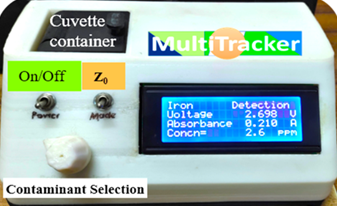
What it means for you
arsenic, fluoride, chromium and iron measured with one device.
not days: results at the well, pump or outlet.
battery-powered and light enough for any field visit.
Performance
Arsenic, fluoride and chromium are invisible, and most villages and sites are hours from a laboratory. This device brings colorimetric testing to the source, so unsafe water is flagged the same day.
Figures are from the research team's prototype validation against laboratory instruments. Performance on your stream is confirmed in our laboratory before design.
Challenge and response
Samples travel for days to a distant laboratory.
Test at the source and read the result on the spot.
Field kits test one contaminant at a time.
One device measures four contaminants in sequence.
Lab instruments are costly and need trained analysts.
Low-cost, built from standard parts, with minimal training.
Unsafe sources stay in use while results are awaited.
Flag unsafe water the same day and act on it.
How it works
Water is mixed with a selective reagent in a cuvette.
A rotary switch picks arsenic, fluoride, chromium or iron.
An LED tuned to that reaction's colour reads the change through a photodetector.
A microcontroller converts the reading to concentration in ppm or ppb.
Use cases
Screen hand pumps, wells and village supplies.
Map arsenic and fluoride hotspots quickly.
Check raw and treated water at every stage.
Check chromium and iron before discharge.
Confirm that arsenic and fluoride removal is working.
Hands-on water chemistry for students and staff.
Comparison
| Factor | Sending samples to a laboratory | Rispri solution |
|---|---|---|
| Turnaround | Days, including transport | Minutes, at the source |
| Contaminants | Separate test for each parameter | Four in one device |
| Equipment | Spectrophotometer or ICP in a laboratory | Battery-powered, 740 g |
| Skills | Trained analyst | Minimal training |
| Accuracy check | Reference methods | Cross-verified against UV-Vis, ICP-AES, ICP-MS and ion-selective electrodes |
Standards and regulations
We design each system to meet your consent conditions and the regulations for your sector, and our laboratory reports against them.
Industries served
Why Rispri
Built on patented and peer-reviewed research from our partnership with IIT Bombay.
Our accredited laboratory characterises your water or waste before design and verifies results after.
The team that builds ETPs, STPs and ZLD plants across India takes each solution from pilot to full scale.
Design, supply, installation, commissioning, operation and testing under one contract.
Questions
Arsenic (III and V), fluoride, hexavalent chromium and iron (II). Results are shown in ppm or ppb and compared with WHO limits.
Results were cross-verified against laboratory UV-Vis spectrophotometers, ICP-AES, ICP-MS and ion-selective electrodes on tap, canal, lake and river water. For regulatory reporting, our NABL-accredited laboratory confirms results.
No. It runs on two 9 V batteries, weighs about 740 g and measures 19.5 × 12.5 × 8 cm.
Up to 28 days.
It is a validated prototype at TRL 5, tested on real water samples. We deploy it with field teams through pilot programmes.
Research partnerships
THE NEXT STEP
Send us a sample or tell us about your site. We will test it, recommend a configuration and set up a pilot.
Request a pilot