
SOLUTIONS / EFFLUENT TREATMENT PLANT
Effluent treatment plants
that pass every inspection.
We design, build and run effluent treatment plants (ETPs) for factories across India. Every design starts with a test of your own effluent in our NABL-accredited laboratory, so the plant is sized for what you actually discharge, not for a textbook average.
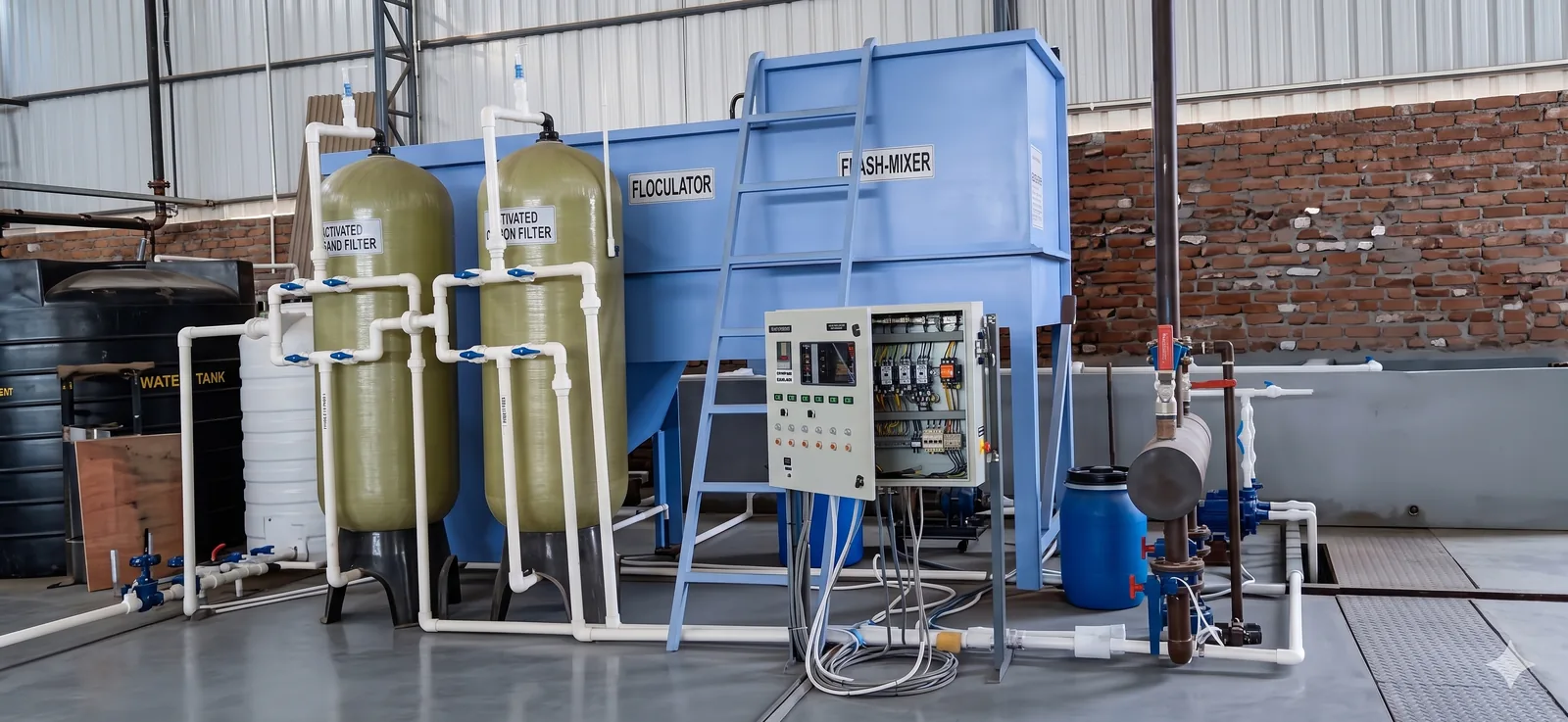
In short
What an effluent treatment plant does.
An effluent treatment plant (ETP) cleans the wastewater a factory produces so that it meets the discharge limits in its consent to operate, or is clean enough to reuse. Most ETPs work in four stages: preliminary (screening, oil and grit removal, equalisation), primary (pH correction, chemical dosing and settling), secondary (biological treatment such as activated sludge or MBBR) and tertiary (filtration and disinfection, plus RO where water is reused). The sludge removed along the way is dewatered and disposed of under the hazardous waste rules.
Under India's general standards, effluent discharged into inland surface water must have a BOD below 30 mg/L, a COD below 250 mg/L, suspended solids below 100 mg/L and a pH between 5.5 and 9.0, unless your consent sets tighter limits.
- 1,498+
- Plants and turnkey projects delivered since 1999
- 4stages
- Preliminary, primary, secondary and tertiary treatment
- 30mg/L
- BOD limit for discharge into inland surface water
- NABL
- Accredited laboratory that tests your effluent before design and after start-up
The basics
Why your factory needs an ETP.
Almost every manufacturing process uses water and gives some of it back dirty: wash water, cooling tower and boiler blowdown, spent process liquor, floor washings and, in many plants, domestic sewage from the canteen and toilets. That wastewater carries organic load (measured as BOD and COD), suspended solids, oil and grease, and sometimes colour, heavy metals or toxic chemicals.
Under the Water (Prevention and Control of Pollution) Act, 1974, a factory that discharges wastewater needs a consent to establish (CTE) before it builds and a consent to operate (CTO) before it runs, both issued by the State Pollution Control Board (SPCB). The consent lists the limits your treated effluent must meet and where it may go: a drain or river, a municipal sewer, your own land for irrigation, or nowhere at all if your consent requires zero liquid discharge.
The Environment (Protection) Rules, 1986 set the general discharge standards, and separate industry-specific standards for sectors such as dairies, distilleries, textiles, pharmaceuticals, tanneries and pulp and paper. Units in the 17 categories of highly polluting industries must also stream their outlet data to the CPCB through online continuous monitoring (OCEMS).
What happens if the ETP does not perform
Boards inspect, sample and increasingly watch online data. A failed sample can lead to a show-cause notice, environmental compensation, a direction to stop production or a disconnection of power and water. A well-designed ETP is cheaper than any of these, and it is also the first step towards reusing water, which many plants now need to do because fresh water is scarce or expensive.
ETP, STP and CETP: the difference
An ETP treats industrial process effluent. A sewage treatment plant (STP) treats domestic wastewater from toilets, kitchens and bathrooms. A CETP is a common effluent treatment plant shared by many small units in an industrial area; members usually pre-treat their effluent before sending it. Many factories run an ETP and an STP side by side, or combine them when the sewage share is small.
How it works
An ETP, stage by stage.
Not every plant needs every stage. Which ones you need depends on what your effluent contains and where it goes, which is why we test it first.
| Stage | What happens | Typical units | What it removes |
|---|---|---|---|
| 1. Preliminary | Large solids, grit and free oil are taken out; flow and strength are evened out over the day. | Bar screen, oil and grease trap, grit chamber, equalisation tank with mixing | Rags, plastics, sand, floating oil; shock loads |
| 2. Primary | pH is corrected and chemicals make fine particles clump together so they can settle or float. | Neutralisation tank, flash mixer, flocculator, primary clarifier or DAF | Suspended solids, emulsified oil, part of the COD, some metals |
| 3. Secondary | Bacteria eat the dissolved organic matter, then settle out as sludge. | Aeration tank (ASP), MBBR, SBR or MBR; UASB first for very strong effluent; secondary clarifier | Most of the BOD and COD, ammonia (with nitrification) |
| 4. Tertiary | The treated water is polished so it meets tight limits or can be reused. | Pressure sand filter, activated carbon filter, UF, RO, chlorination or UV | Residual solids, colour, odour, bacteria; dissolved salts with RO |
| Sludge handling | Settled sludge is thickened and dewatered to a cake for authorised disposal. | Sludge thickener, filter press, screw press or centrifuge, sludge drying beds | Water in the sludge, cutting disposal cost |
Our NABL-accredited laboratory tests pH, BOD, COD, TSS, TDS, oil and grease, and heavy metals, and an engineer tells you which stages you need.
Process options
Which biological process should you choose?
The secondary stage decides most of the footprint, power bill and outlet quality. These are the options we design most often, and when each one makes sense.
| Process | Best for | Footprint | Outlet quality | Watch-outs |
|---|---|---|---|---|
| Activated sludge (extended aeration) | Steady, moderate-strength effluent where land is available | Large | Good | Sludge bulking if the load swings; needs a well-run clarifier |
| MBBR | Space-limited sites, upgrades of existing tanks, variable loads | Small to medium | Good | Media must be retained by screens; still needs a clarifier or DAF after it |
| SBR | Intermittent or batch flows, plants that need nitrogen removal | Medium | Very good | Relies on automation and a reliable PLC |
| MBR | Water reuse, very tight limits, little space | Smallest | Excellent, RO-ready | Higher power and membrane replacement cost; needs good pre-treatment |
| Anaerobic (UASB) + aerobic | High-strength organic effluent (COD of several thousand mg/L), e.g. food, dairy, distillery | Medium | Good after the aerobic polish | Slow start-up; produces biogas that can be used as fuel |
| Physico-chemical only | Inorganic effluent: metal finishing, glass, some chemical units | Small | Depends on chemistry | Chemical cost and sludge volume; no use for dissolved organics |
Footprint and quality are relative. Many plants combine processes, for example DAF before MBBR for oily effluent, or UASB before activated sludge for food processing.
Discharge limits
The limits your treated effluent must meet.
These are the general standards for discharge into inland surface water under Schedule VI of the Environment (Protection) Rules, 1986. Your consent to operate may be stricter, and industry-specific standards apply to many sectors.
| Parameter | Inland surface water |
|---|---|
| pH | 5.5 to 9.0 |
| Total suspended solids | 100 |
| BOD (3 days at 27 °C) | 30 |
| COD | 250 |
| Oil and grease | 10 |
| Ammoniacal nitrogen (as N) | 50 |
| Total Kjeldahl nitrogen (as N) | 100 |
| Total residual chlorine | 1.0 |
| Phenolic compounds | 1.0 |
| Sulphide (as S) | 2.0 |
| Fluoride (as F) | 2.0 |
| Hexavalent chromium | 0.1 |
| Total chromium | 2.0 |
| Lead | 0.1 |
| Mercury | 0.01 |
| Copper | 3.0 |
| Zinc | 5.0 |
| Cyanide (as CN) | 0.2 |
Cost
How much does an effluent treatment plant cost?
The honest answer is that it depends on how strong your effluent is, not only on how much of it there is. A 100 KLD dairy ETP and a 100 KLD engineering-unit ETP are very different plants. These ranges help you budget before we see your data.
| Capacity | Typical use | Indicative plant cost* |
|---|---|---|
| 10 to 25 KLD | Small units, packaged or skid-mounted ETP | ₹6 to 15 lakh |
| 50 KLD | Small and medium factories | ₹15 to 35 lakh |
| 100 KLD | Medium factories, food and pharma units | ₹25 to 60 lakh |
| 500 KLD | Large plants | ₹1 to 2.5 crore |
| 1 MLD and above | Large plants and CETPs | ₹2 crore upwards |
*Indicative 2026 ranges for a conventional biological ETP: equipment, electricals and installation, excluding land, civil works, taxes and any RO or ZLD stage. High-strength, toxic or high-TDS effluent costs more. We give a firm price after testing your effluent and seeing the site.
What drives capital cost
- Organic load (BOD/COD), not just flow
- Discharge route: river, sewer, land or ZLD
- Civil tanks vs pre-fabricated or containerised
- Space available and soil conditions
- Level of automation and online monitoring
What drives running cost
- Power, mostly for aeration blowers
- Chemicals for pH, coagulation and disinfection
- Sludge dewatering and authorised disposal
- Operators and daily lab checks
- Membrane and media replacement
Where money is usually wasted
- Plants sized on assumed, not measured, effluent
- Undersized equalisation tanks
- Oversized blowers running round the clock
- Wrong chemical dosing without jar tests
- No sludge plan, so sludge piles up
We audit existing plants, tune aeration and dosing, retrofit MBBR into old tanks and supply treatment chemicals that are tested on your effluent.
Troubleshooting
Common ETP problems, and how we fix them.
- 01The problem
Outlet COD or BOD above the consent limit.
What we doTest inlet and every stage to find where removal fails, then correct the load, oxygen supply or retention time, often with an MBBR retrofit in the existing tank.
- 02The problem
Sludge floats or will not settle in the clarifier (bulking).
What we doCheck food-to-microorganism ratio, dissolved oxygen and nutrients under the microscope, then fix the cause instead of dosing more chemicals.
- 03The problem
Foaming, bad odour or black, septic water.
What we doFind dead zones and low-oxygen areas, repair or resize diffusers and blowers, and remove fats and surfactants upstream.
- 04The problem
Production has grown and the plant is overloaded.
What we doIncrease capacity within the same footprint with MBBR media, DAF or MBR, so you avoid building new tanks.
- 05The problem
The board wants reuse or ZLD, and TDS keeps rising.
What we doAdd UF and RO for reuse, and an evaporator for the reject; our non-thermal evaporators take the RO reject off a steam MEE at a fraction of the cost.
By industry
Every industry's effluent is different.
The same 100 KLD can mean very different plants. These guides explain what each sector's effluent contains and how we treat it.
Pharmaceutical ETP
High COD, solvents and salts from batch production; often ZLD.
Pharma guide →Chemical industry ETP
Toxic, high-TDS or hard-to-degrade streams that need segregation.
Chemical guide →Spent coolant and oily water
Emulsions from machining that must be broken before treatment.
Coolant guide →Buying guide
What to ask before you buy an ETP.
Use this list with any supplier, including us.
- Was the design based on a test of my effluent? Composite samples over a full production cycle, not one grab sample.
- Which outlet values are guaranteed? In writing, against the limits in my consent.
- What is the power and chemical cost per cubic metre? Ask for the calculation, not a single number.
- How is sludge handled? Dewatering method, cake dryness and disposal route.
- Who runs it after commissioning? Training, an O&M contract and spare parts support.
- Can it grow with my production? Space and design margin for a future stage or reuse.
- Is online monitoring included if I need OCEMS? Analysers, data logger and CPCB connectivity.
- Who tests the outlet? A NABL-accredited laboratory report carries weight with the board.
Why Rispri
One team from sample to running plant.
Our own NABL lab
We test your effluent before design and certify the outlet after start-up, so there is no gap between the designer and the tester.
Engineering since 1999
1,498+ plants and turnkey projects for industries, hotels, hospitals and cities.
Chemicals and spares in house
Treatment chemicals and genuine spares from our own catalogue keep running costs predictable.
Operate and maintain
O&M contracts with trained operators, monthly lab reports and compliance support with your board.
Questions
Effluent treatment plant FAQs.
What is an effluent treatment plant?
An effluent treatment plant (ETP) is a set of tanks and equipment that removes pollutants from industrial wastewater so that it meets the discharge limits in the factory's consent to operate or can be reused. It usually combines physical, chemical and biological treatment, followed by filtration and disinfection.
Is an ETP mandatory for my factory?
If your unit discharges process wastewater, your State Pollution Control Board will require treatment to the limits in your consent to establish and consent to operate under the Water Act, 1974. Small units in an industrial area may instead send pre-treated effluent to a CETP, if the board allows it.
What is the difference between an ETP and an STP?
An ETP treats industrial process effluent, which can contain chemicals, oil, colour or metals. An STP treats domestic sewage from toilets, kitchens and bathrooms, which is mostly biodegradable. Many factories run both, or treat sewage together with effluent when the sewage share is small.
What are the CPCB discharge limits for treated effluent?
For discharge into inland surface water, the general standards include pH 5.5 to 9.0, BOD below 30 mg/L, COD below 250 mg/L, total suspended solids below 100 mg/L and oil and grease below 10 mg/L. Industry-specific standards and your own consent can be stricter.
How much does an effluent treatment plant cost in India?
As an indication, a conventional biological ETP costs about ₹15 to 35 lakh at 50 KLD and ₹25 to 60 lakh at 100 KLD for equipment and installation, excluding civil work and land. The real cost depends mostly on how strong your effluent is and where it is discharged, so we price after testing it.
What does it cost to run an ETP?
Running cost is made up of power (mostly aeration), chemicals, sludge disposal, operators and lab tests. It varies widely with effluent strength; we calculate it per cubic metre for your design and help existing plants reduce it through aeration and dosing optimisation.
Which treatment process is best: ASP, MBBR, SBR or MBR?
None is best for every plant. Activated sludge suits steady loads where land is available, MBBR suits tight spaces and upgrades, SBR suits batch flows, and MBR suits water reuse and very strict limits. Strong organic effluent often needs an anaerobic stage first.
How much space does an ETP need?
It depends on capacity, effluent strength and the process chosen. MBBR and MBR plants need much less area than conventional activated sludge, and packaged or containerised plants suit small capacities. We fit the design to the space you have.
How long does it take to build an ETP?
Small packaged plants can be delivered in a few weeks. Larger civil-based plants usually take a few months from design approval to commissioning, plus the time the biology needs to stabilise after start-up.
Can treated effluent be reused?
Yes. After tertiary filtration, and RO where dissolved salts must be removed, treated effluent can feed cooling towers, boilers, washing, gardening and some process uses. Reuse often pays back quickly where fresh water or tanker water is expensive.
When do I need zero liquid discharge?
When your consent or a CPCB direction says no effluent may leave the site, which is common for textiles, pharma, distilleries and units in water-stressed or sensitive areas. The ETP is then followed by RO and an evaporator to turn the reject into solid salt.
Do you operate and maintain ETPs?
Yes. We run ETPs under O&M contracts with trained operators, supply chemicals and spares, and provide monthly NABL-accredited test reports you can submit to your board. We also take over and fix plants built by others.
Related