SOLUTIONS / ZERO LIQUID DISCHARGE PLANT
Zero liquid discharge plants
that you can afford to run.
We design, build, fix and operate ZLD systems for Indian industry: effluent treatment, high-recovery RO, evaporators, crystallisers and dryers. We size every stage on a measured mass balance of your effluent, and we cut the steam bill that makes most ZLD plants so expensive.
In short
What a zero liquid discharge plant does.
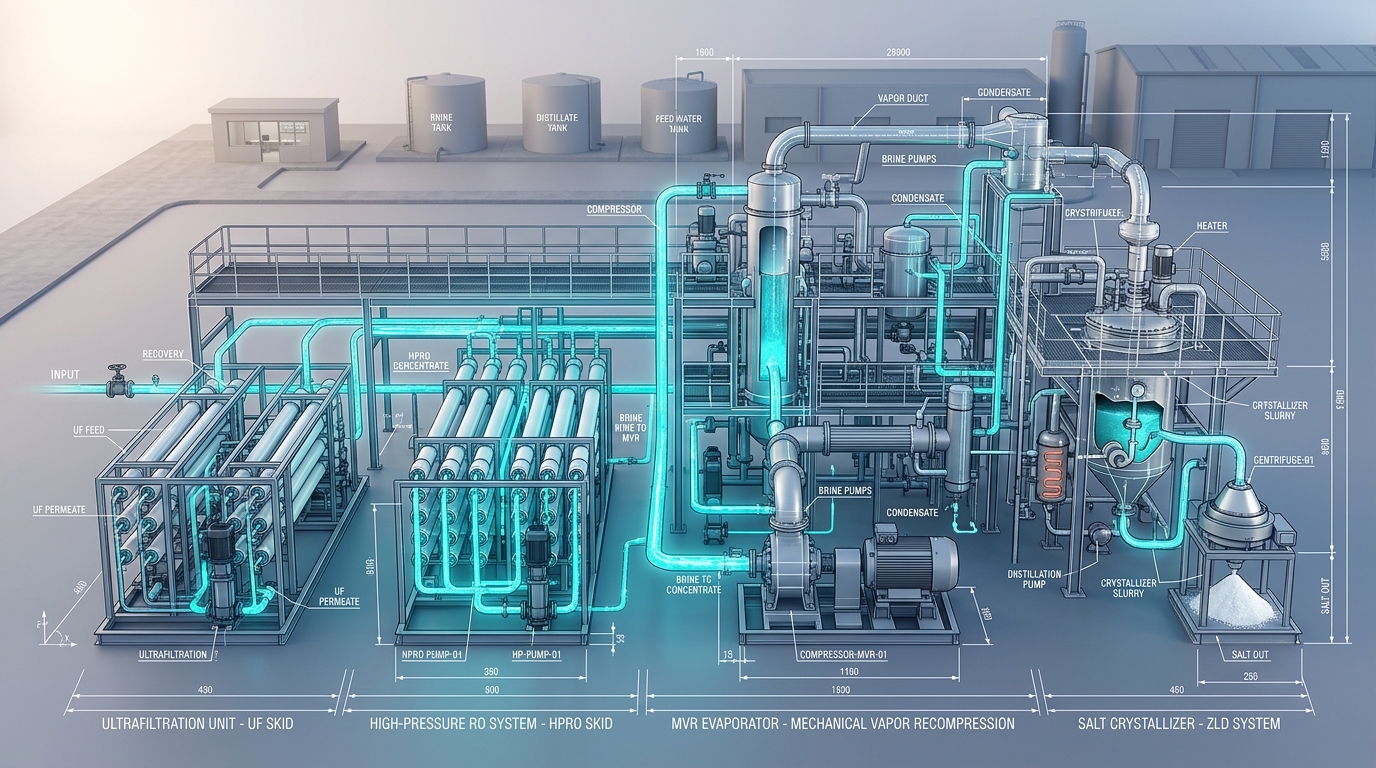
A zero liquid discharge (ZLD) plant is a treatment system that recovers almost all of a factory's wastewater for reuse and leaves only solid waste, so no liquid effluent leaves the site. It works in steps: the effluent is first treated in an ETP, then reverse osmosis (RO) recovers most of the water, an evaporator boils or air-dries the salty RO reject, and a crystalliser or dryer turns what is left into dry salt. The recovered water goes back to the process, boiler or cooling tower.
In India, ZLD is required where the State Pollution Control Board writes it into a factory's consent, which is common for textiles, distilleries, tanneries, pulp and paper, pharma and units in water-stressed areas. The dry salt and sludge are then handled under the Hazardous and Other Wastes Rules, 2016.
- 50–65%
- Share of a ZLD plant's cost taken by the evaporation stage
- ₹80–160/m³
- Running cost of our non-thermal RCD evaporator, against an estimated ₹430–1,070 in an MEE
- 2015
- Year CPCB issued its ZLD guidelines for water-polluting industries
- 1,498+
- Plants and turnkey projects delivered since 1999
The basics
What is ZLD, and how is it different from MLD?
Zero liquid discharge (ZLD) means that the only things leaving your site from the water circuit are reused water, water vapour and solid waste. There is no outlet pipe to a drain, river, sewer or land. Boards check this by looking at your water meters, your evaporator logs and whether any pipe, tanker or bypass takes effluent out.
Minimal liquid discharge (MLD) is the less extreme version. The plant recovers most of the water, typically with ETP, UF and RO, but sends a small, concentrated stream to an approved route such as a common effluent treatment plant (CETP), instead of evaporating it to dryness. MLD avoids the most expensive part of ZLD, the evaporator and dryer, so it costs far less to run. It is only an option where your consent allows a discharge.
Who has to do ZLD?
There is no single list that applies everywhere. ZLD becomes compulsory for you when it is written into your consent to establish or consent to operate under the Water Act, 1974, or ordered in a direction from the CPCB, SPCB, a court or the National Green Tribunal. In practice it is most often imposed on:
- Textile dyeing and processing units, especially in clusters where rivers or groundwater are already polluted. Units in Tirupur, Tamil Nadu, have run under ZLD conditions for over a decade.
- Molasses-based distilleries, where spent wash is concentrated and incinerated or composted instead of discharged.
- Tanneries, pulp and paper mills and pharmaceutical and bulk drug units, often by consent condition.
- Units in water-stressed or ecologically sensitive areas, such as river basins under special protection or over-exploited groundwater blocks.
CPCB's 2015 guidelines on the techno-economic feasibility of ZLD for water-polluting industries looked at sectors such as distilleries, textiles, tanneries and pulp and paper. Always read the exact wording of your own consent: some say "zero discharge", some allow treated water for gardening, and some name the technology.
Why ZLD is harder than it looks
An ETP removes organic pollution, but it does not remove dissolved salts (measured as TDS, total dissolved solids). When you reuse water again and again, those salts build up. ZLD has to take every kilogram of salt that enters the factory, from raw water, chemicals and the process itself, and take it out as a solid. That is why the evaporator and salt handling, not the ETP, decide whether a ZLD plant works.
How it works
The ZLD process train, step by step.
Each stage hands a smaller, saltier stream to the next. The more water each stage recovers cheaply, the less has to be boiled at the end.
| Step | What happens | Typical equipment | Why it matters for ZLD |
|---|---|---|---|
| 1. Segregation | Streams are kept apart at source: strong salty streams, high-organic streams, cooling and boiler blowdown, sewage. | Separate drains, collection tanks, flow meters | A small, very salty stream can sometimes go straight to the evaporator, so it never dilutes the rest and load on RO falls. |
| 2. Effluent treatment | Organic load, oil and suspended solids are removed. | Equalisation, neutralisation, clarifier or DAF, biological treatment (ASP, MBBR, MBR) | Organics left in the water foul membranes and cause foaming and sticky salt in the evaporator. |
| 3. Tertiary treatment | Fine solids, colour and bacteria are removed to protect the membranes. | Pressure sand and carbon filters, ultrafiltration (UF), cartridge filters | RO life depends on this stage. UF gives a steady, low-turbidity feed. |
| 4. Softening and high-recovery RO | RO pushes water through membranes and rejects the salts. Two or three stages in series, with softening or pH control between them, push recovery up. | Multi-stage RO, chemical or ion-exchange softening, decarbonation, antiscalant dosing, seawater-grade or high-pressure RO on the reject | Every extra point of recovery shrinks the evaporator feed. Hardness and silica set the limit. |
| 5. Reject concentration | RO reject is concentrated further before thermal evaporation where it pays. | High-pressure RO, non-thermal RCD evaporator, forward osmosis | Cheaper than steam for removing the first part of the water. |
| 6. Evaporation | The brine is boiled (or air-dried) until it is close to saturation; the vapour is condensed as clean water. | Multiple-effect evaporator (MEE), MVR evaporator, non-thermal RCD evaporator | The costliest step. Steam price and scaling decide your running cost. |
| 7. Crystallisation and drying | The thick concentrate is turned into solid salt or a dry powder. | Forced-circulation crystalliser with centrifuge, agitated thin film dryer (ATFD), spray dryer | Mother liquor from the crystalliser must still go somewhere: usually the ATFD. |
| 8. Salt and sludge handling | Salt and sludge are bagged, stored in a covered area and sent to an authorised facility or user. | Bagging, covered hazardous waste store, manifests | If this step is not planned, salt piles up on site and becomes a compliance problem. |
| 9. Condensate and permeate reuse | RO permeate and evaporator condensate return to the process, boiler or cooling tower. | Condensate polishing (carbon, RO or stripping), storage, reuse pumps | Condensate can carry ammonia and volatile organics, so it is tested before boiler use. |
What "high-recovery RO" means
A normal two-stage RO on treated effluent recovers about 70 to 80% of the water before calcium, magnesium, silica and barium start to scale the last membranes. High-recovery schemes remove that limit by softening the water first and, in some designs, running the final stage at high pH where silica stays dissolved. This idea is often called HERO (high-efficiency RO). With good pre-treatment, overall recovery of around 90% or more is realistic on many effluents, which can halve the evaporator load compared with a basic RO.
Our NABL-accredited laboratory measures TDS, hardness, silica, sulphate, chloride, COD and metals in your effluent and RO reject, so RO recovery and evaporator size are based on numbers, not guesses.
Technology options
MEE, MVR, non-thermal, ponds, ATFD: which evaporation technology?
The back end of a ZLD plant is where technology choice changes your running cost the most. This is how the options compare.
| Technology | How it works | Energy | Best for | Watch-outs |
|---|---|---|---|---|
| Multiple-effect evaporator (MEE) | Steam boils the brine in the first effect; its vapour heats the next effect, and so on through 3 to 6 effects. | Boiler steam plus pumps; efficiency (COP) about 3 to 5 | Plants with their own boiler and cheap fuel; mixed, variable brines | High steam cost, tube scaling, foaming, condensate contamination |
| Mechanical vapour recompression (MVR) | A compressor or fan re-compresses the vapour so it can heat the same evaporator again. | Mostly electricity; little or no live steam once running | Steady, large flows; sites with costly steam and reliable power | Higher capital cost; sensitive to boiling point rise in very salty brines; compressor maintenance |
| Non-thermal RCD evaporator | Slowly rotating disks lift a thin film of reject into moving air, which carries the water away as vapour. | Fan and pump only; about 10–20 kWh per m³; COP about 24 to 60 | Cutting MEE load in existing plants; new plants in hot, dry areas or with waste heat | Water goes to air, not recovered as condensate; output depends on weather; needs ground area |
| Solar evaporation ponds | Brine is spread in lined ponds and left to evaporate in the sun. | None | Rarely acceptable today | Large land, liner leaks into groundwater, overflow in monsoon, salt and odour; many boards no longer accept ponds for ZLD |
| Forced-circulation crystalliser | Concentrate is pumped fast through a heater and flashed so salt crystals grow and are separated in a centrifuge. | Steam or MVR | Recovering a cleaner salt, splitting sodium chloride and sulphate | Needs a purge (mother liquor) stream; organics spoil crystal quality |
| Agitated thin film dryer (ATFD) | Rotating blades spread concentrate on a steam-heated wall and scrape off dry powder. | Steam; the most steam per kg of water of any stage | Final drying of MEE concentrate and crystalliser mother liquor | Sticky, hygroscopic salts, blade wear, dust; keep its load as small as possible |
Efficiency figures for the RCD evaporator come from our development work with IIT Bombay and are confirmed on your stream by laboratory tests and a site pilot. MEE and MVR performance depends on the number of effects, brine chemistry and steam conditions.
Our non-thermal RCD evaporators, developed with IIT Bombay, take part of the RO reject off your MEE without changing the rest of the plant. Moving a quarter of the load cuts evaporation cost by about 15–25%; moving half cuts it by about 30–45%.
Rules
The rules behind zero liquid discharge.
ZLD has no outlet limit table, because nothing is discharged. Instead, these rules decide whether you need ZLD and how its waste must be handled.
| Rule | What it means for a ZLD plant |
|---|---|
| Water (Prevention and Control of Pollution) Act, 1974 | Your consent to establish and consent to operate set whether ZLD applies. Breaching it can bring closure, power cut-off or environmental compensation. |
| CPCB ZLD guidelines, 2015 | Guidance on the techno-economic feasibility of ZLD for water-polluting industries; boards use it when writing conditions. |
| Environment (Protection) Rules, 1986 | Industry-specific standards for sectors such as distilleries, textiles and tanneries; directions under the Environment (Protection) Act, 1986. |
| Hazardous and Other Wastes (Management and Transboundary Movement) Rules, 2016 | Evaporator salt, ATFD powder and ETP sludge from many industries are hazardous waste. You need an authorisation, a covered store, records, manifests and disposal to a TSDF or an authorised user. |
| CGWA guidelines, 2020 | Groundwater users need a no-objection certificate, metering and, for industry, water audits. ZLD reduces how much fresh water you draw. |
| OCEMS and flow metering directions | Highly polluting units stream data to the CPCB; boards often ask ZLD units for meters on intake, RO permeate, reject and evaporator feed. |
Cost
How much does a ZLD plant cost?
ZLD cost is decided less by your effluent flow and more by how much water reaches the evaporator and how you evaporate it. This is where the money goes.
| Stage | Share of capital cost | Share of running cost | Biggest lever |
|---|---|---|---|
| ETP and tertiary (UF) | Moderate | Low to moderate (aeration power, chemicals) | Remove organics well so RO and evaporator do not foul |
| RO (all stages, with softening) | Moderate | Moderate (high-pressure pumps, antiscalant, membranes) | Higher recovery means a smaller evaporator |
| Evaporation, crystallisation, drying | Highest: together about 50–65% of total ZLD cost | Highest (steam or power) | Fewer m³ to evaporate, and a cheaper way to evaporate them |
| Salt and sludge disposal | Low | Moderate and rising (TSDF fees, transport) | Salt recovery and reuse where a buyer exists |
A worked example: why RO recovery and evaporator choice matter
| Scenario | Reject to evaporate | Evaporation cost per day | Per year (365 days) |
|---|---|---|---|
| RO at 80% recovery, all reject to MEE | 20 m³/day | ₹8,600 to 21,400 | About ₹31 to 78 lakh |
| RO at 90% recovery, all reject to MEE | 10 m³/day | ₹4,300 to 10,700 | About ₹16 to 39 lakh |
| RO at 80%, half the reject moved to RCD | 10 m³/day MEE + 10 m³/day RCD | ₹5,100 to 12,300 | About ₹19 to 45 lakh |
| RO at 90%, half the reject moved to RCD | 5 m³/day MEE + 5 m³/day RCD | ₹2,550 to 6,150 | About ₹9 to 22 lakh |
Indicative arithmetic for budgeting only. It excludes the ETP, RO, crystalliser, ATFD, labour and salt disposal. Your own figures depend on steam cost, brine chemistry and climate; we confirm them after testing your effluent and, for RCD units, a site pilot. As a reference point, the evaporator for a 100 KLD pharma ZLD alone can cost ₹4 to 8 crore.
What drives capital cost
- Volume of reject reaching the evaporator
- TDS, hardness, silica and organics in the brine
- Evaporator type and number of effects
- Material of construction (duplex, titanium for chlorides)
- Crystalliser, ATFD and salt store size
What drives running cost
- Steam: fuel price and boiler efficiency
- Power for RO high-pressure pumps and MVR
- Antiscalants, softening chemicals, cleaning acids
- Membrane replacement
- Salt and sludge disposal fees
Where ZLD money is wasted
- Evaporator sized on flow, not on a salt balance
- Low RO recovery because softening was skipped
- Clean and dirty streams mixed before RO
- Frequent shutdowns for acid cleaning
- Salt stored on site for want of a disposal plan
Our forward osmosis system, developed with ICT Mumbai, dewatered up to 86% of RO reject in pilot runs at under 2 bar, cutting the volume that has to be evaporated.
Salt recovery
Can you recover and sell the salt?
Sometimes. Most ZLD plants produce a mixed salt: sodium chloride, sodium sulphate, some calcium and magnesium salts and whatever organics survived treatment. Mixed salt has little value and usually goes to a TSDF as hazardous waste.
Where one or two salts dominate, they can be separated. Nanofiltration lets chloride pass and holds back sulphate, splitting the brine into two streams. In the crystalliser, temperature does the rest: sodium chloride dissolves about equally well hot or cold, while sodium sulphate behaves very differently with temperature, so it can be crystallised on its own by heating or chilling. Textile units that use a lot of Glauber's salt (sodium sulphate) in dyeing can then reuse the recovered salt or brine in the dye house.
The limits
- Organics and colour left in the brine discolour the salt and make it sticky. Good biological treatment and carbon polishing come first.
- A purge stream of impure mother liquor always remains and still has to be dried.
- Recovered salt needs a buyer or an internal use, and reuse may need the board's approval.
- Salt recovery adds capital cost; it pays where salt use or disposal cost is high.
We study salt recovery as part of our process design and circularity work, including solubility analysis and a purity target before any equipment is chosen.
Troubleshooting
Why ZLD plants fail, and how we fix them.
Many ZLD plants in India run well below design. These are the failures we see most often when we are called in.
- 01The problem
RO membranes scale or foul within weeks; recovery falls and the evaporator overloads.
What we doAutopsy the membrane and analyse the scale, fix pre-treatment (UF, softening, pH), re-select the antiscalant and set a cleaning schedule based on pressure drop.
- 02The problem
MEE tubes scale up and the plant stops for acid cleaning every few weeks.
What we doRemove calcium and silica before the evaporator, adjust concentration in each effect, add seeding or anti-scalant, and move part of the load to a non-thermal evaporator that is cleaned online.
- 03The problem
Foaming and carry-over: the condensate is dirty and cannot be reused.
What we doFind the organics or surfactants upstream, improve biological and carbon treatment, dose a tested antifoam, and add condensate polishing.
- 04The problem
Steam cost is so high that the evaporator is run part-time and reject is stored.
What we doRaise RO recovery, segregate weak streams away from the evaporator, and retrofit RCD evaporators or MVR to cut steam use.
- 05The problem
Salt and ATFD powder pile up on site with nowhere to go.
What we doTest the salt, prepare the hazardous waste paperwork, arrange the authorised route, and study salt splitting to reduce the volume that needs a TSDF.
- 06The problem
Low uptime: the plant was designed for a textbook effluent and cannot handle real variation.
What we doRebuild the water and salt balance from measured data, add equalisation and buffer storage, and take over operation under an O&M contract if needed.
By industry
ZLD looks different in every sector.
Textile dyeing ZLD
Colour and high TDS from Glauber's salt and common salt; sulphate recovery is often worth studying.
Textile guide →Pharmaceutical ZLD
Solvent-laden, high-COD streams that must be segregated before RO or sent straight to the evaporator.
Pharma guide →Chemical industry ZLD
Very salty, sometimes toxic streams; material selection and salt disposal decide the design.
Chemical guide →Food and beverage reuse
Biodegradable effluent; biogas first, then RO for reuse, often MLD rather than full ZLD.
Food guide →Dairy water recovery
CIP washes and whey water; reuse before evaporation keeps ZLD small.
Dairy guide →Buying guide
What to ask before you buy a ZLD plant.
Use this list with any supplier, including us.
- Is there a written water and salt mass balance? Every stream, its flow and its TDS, hardness, silica and COD, measured over a production cycle.
- What RO recovery is guaranteed, and with what pre-treatment? Ask how hardness and silica are controlled.
- What is the steam and power use per m³ evaporated? Ask for the evaporator's steam economy and your cost per m³ at your fuel price.
- What is the guaranteed uptime, and how often must the evaporator be cleaned?
- What happens to the mother liquor and salt? Dryer capacity, salt store size and disposal route.
- Is the condensate fit for reuse? Ask what polishing is included and where the water goes.
- Which materials are used in the evaporator? Chloride-rich brine needs the right alloy.
- Can the plant be expanded or retrofitted with lower-cost evaporation later?
Why Rispri
ZLD built on a real mass balance.
Our own NABL lab
We measure the chemistry that decides RO recovery and evaporator scaling, and test salt and condensate after start-up.
Lower-cost evaporation
Non-thermal RCD evaporators developed with IIT Bombay and forward osmosis developed with ICT Mumbai, alongside MEE and MVR.
Engineering since 1999
1,498+ plants and turnkey projects, from ETPs and RO to complete ZLD systems.
Chemicals and O&M
Antiscalants, cleaning chemicals, spares and operators to keep the plant at design uptime.
Questions
Zero liquid discharge FAQs.
What is a zero liquid discharge plant?
A zero liquid discharge (ZLD) plant treats and recycles a factory's wastewater so that no liquid effluent leaves the site. It combines an effluent treatment plant, reverse osmosis, an evaporator and a crystalliser or dryer, and leaves only reusable water and solid salt and sludge.
What is the difference between ZLD and MLD?
ZLD evaporates all remaining brine to solids, so nothing liquid is discharged. Minimal liquid discharge (MLD) recovers most of the water with RO but sends a small concentrated stream to an approved route such as a CETP. MLD costs much less to run, but is only allowed if your consent permits some discharge.
Is ZLD mandatory in India?
It is mandatory when your State Pollution Control Board writes it into your consent, or when the CPCB, a court or the NGT directs it. This is common for textiles, distilleries, tanneries, pulp and paper, pharma and units in water-stressed or sensitive areas. Check the exact wording of your consent to operate.
How much does a ZLD plant cost in India?
It depends mostly on how much water reaches the evaporator and how it is evaporated, not just on effluent flow. Evaporation alone takes about 50–65% of ZLD cost. We give an indicative budget after a mass balance and a firm price after testing your effluent.
What does it cost to evaporate one cubic metre of RO reject?
In a steam MEE, our conservative estimate is about ₹430 to 1,070 per m³, depending on fuel price and number of effects. Our non-thermal RCD evaporator costs about ₹80 to 160 per m³ with power at ₹8 per kWh. These are indicative and are confirmed on your stream.
What is the difference between MEE and MVR?
An MEE uses boiler steam and reuses its vapour across several effects. An MVR evaporator uses a compressor to recycle the vapour's heat, so it runs mainly on electricity and needs little live steam. MVR costs more to buy but less to run where steam is expensive.
Are solar evaporation ponds allowed for ZLD?
Many pollution control boards no longer accept them, because ponds need large land, leak salt into groundwater and overflow in the monsoon. Check with your board before planning one; mechanical or non-thermal evaporation is the safer route.
How much water can a ZLD plant recover?
Nearly all the water entering the effluent system is recovered as RO permeate and evaporator condensate, apart from water lost to air in cooling towers or non-thermal evaporators and moisture in the sludge and salt. The RO stage usually recovers the largest share.
What happens to the salt from a ZLD plant?
Mixed salt and dryer powder are usually hazardous waste under the Hazardous and Other Wastes Rules, 2016, and go to an authorised TSDF. Where sodium sulphate or sodium chloride can be separated pure enough, they can sometimes be reused, for example in textile dyeing.
Can my existing MEE be made cheaper to run?
Yes. The quickest saving usually comes from raising RO recovery and from moving part of the reject to a non-thermal evaporator installed beside the MEE. Moving a quarter of the load cuts evaporation cost by about 15–25%, and half the load by about 30–45%.
Can MEE condensate be reused in the boiler?
Often, but test it first. Condensate can carry ammonia and volatile organics from the effluent; it may need carbon filtration, stripping or an RO pass before boiler use. Cooling tower make-up is usually the easier first reuse.
How long does it take to build a ZLD plant?
A turnkey ETP and ZLD plant typically takes 12 to 16 weeks from detailed mass balance engineering to commissioning, depending on capacity and site work. Retrofits of individual stages such as RCD evaporators can be phased in modules.
Do you operate ZLD plants?
Yes. We run ZLD plants under O&M contracts with trained operators, supply antiscalants and cleaning chemicals, keep water and salt balance records and provide NABL-accredited test reports for your board. We also take over plants built by others.
Related