
INDUSTRIES / CONSTRUCTION
Construction site water treatment
from labour camp STP to recycled wash water.
A construction site is a temporary town and a small factory at once. It needs safe drinking water and sewage treatment for its workers, a plan for dewatering and muddy runoff, and, at the batching plant, a way to reuse alkaline wash water. We supply the plants and test the water so you meet your clearance conditions.
In short
How water is managed on a construction site.
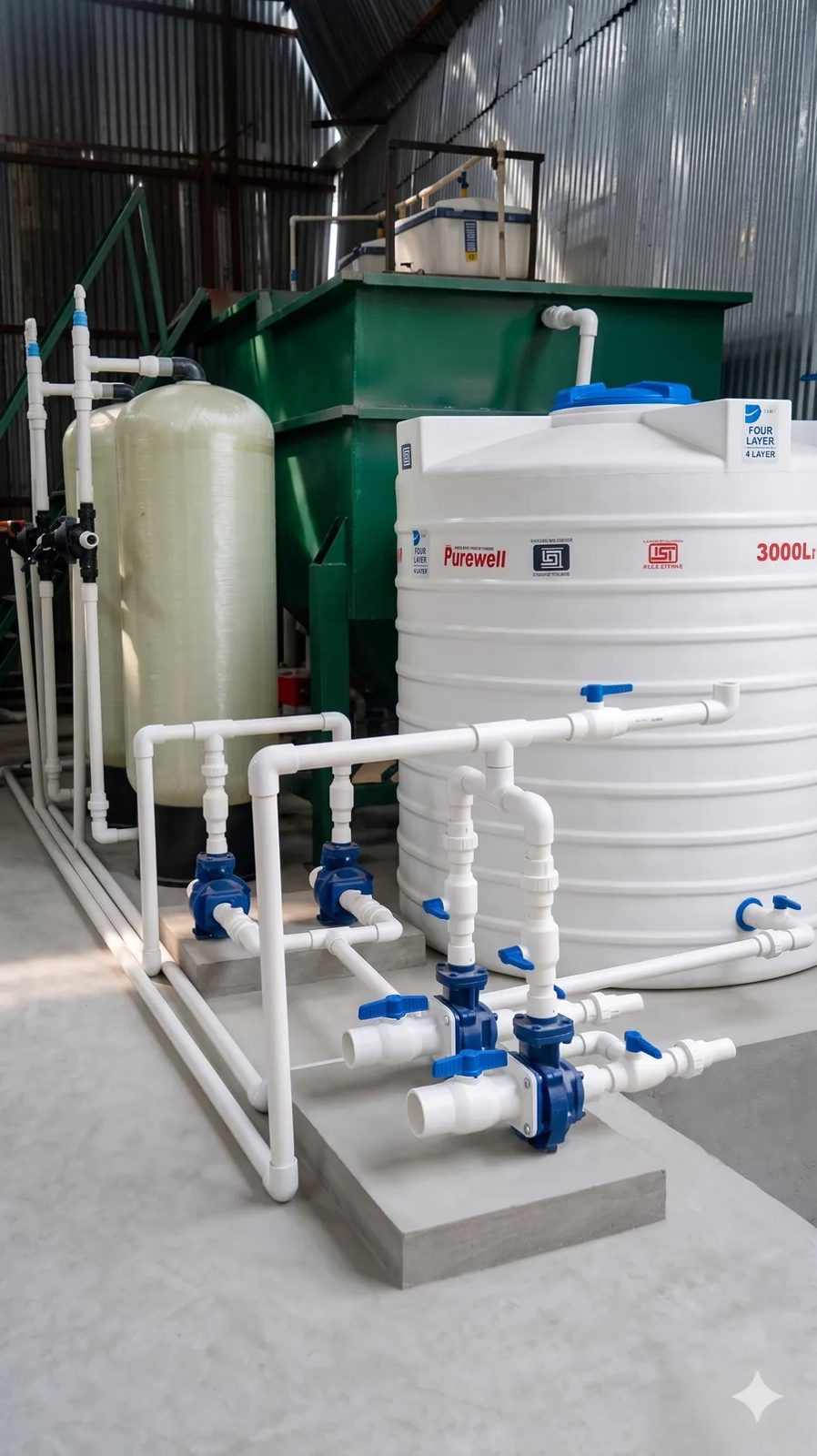
Construction site water treatment deals with four streams. Sewage from labour camps and site offices is treated in a packaged or modular STP that can be moved to the next site. Dewatering water pumped from excavations is settled and reused for curing, dust suppression or recharge rather than wasted. Silt-laden runoff is held in settling ponds before it leaves the site. Wash water from ready-mix concrete (RMC) plants, transit mixers and wheel washes, which is highly alkaline and full of fines, is settled and recycled into concrete or washing. Workers' drinking water must meet IS 10500, and mixing water must meet IS 456.
- 20,000m²
- Built-up area from which building projects need environmental clearance under the EIA Notification, 2006
- 11–13pH
- Typical pH of concrete washout water, too alkaline to discharge untreated
- 500mg/L
- Acceptable TDS limit for drinking water in IS 10500 (2,000 permissible without an alternative source)
- 6pH min.
- Lowest pH allowed for concrete mixing water under IS 456
Water streams
Where does wastewater come from on a construction site?
Most site water problems come from a few predictable sources. Each changes as the project moves from excavation to structure to finishing, so the plan should change with it.
| Source | When it peaks | Typical character | Why it matters |
|---|---|---|---|
| Labour camp and site office sewage | Throughout, highest at peak manpower | Domestic sewage: BOD about 200 to 350 mg/L, suspended solids, faecal bacteria | Untreated sewage spreads disease and breaks clearance and consent conditions |
| Dewatering water | Excavation and basement works | Groundwater, clear to turbid; quality depends on the aquifer | Large volumes; often good enough to reuse after settling |
| Stormwater runoff | Monsoon, while soil is exposed | Very high suspended solids (silt and clay), sometimes cement and oil | Chokes drains and silts up lakes and streams |
| RMC plant and transit mixer washout | During concreting | pH about 11 to 13, high suspended solids, fines and cement | Alkaline and abrasive; harms soil, drains and aquatic life |
| Wheel and tyre wash | Earthworks and wet weather | Mud, grit, some oil | Stops mud tracking onto public roads; needs a closed loop |
| Curing water | Structure stage | Clean water that runs off slabs and members | A large water use that can be cut with curing compounds and covers |
| Vehicle and equipment yard | Throughout | Oily wash water, diesel spills | Oil contaminates soil and STPs; used oil is hazardous waste |
An RMC plant is the one place on a site that behaves like a small factory: it uses water every day, and its wash water has a consistent character that makes recycling straightforward once it is designed in.
Rules
Which rules govern water on construction sites?
Water conditions reach a site through its environmental clearance, the SPCB consent (for larger projects and RMC plants), groundwater rules, and labour laws.
| Rule | What it asks for |
|---|---|
| EIA Notification, 2006 | Building and construction projects of 20,000 m² built-up area and above, and townships and area development projects above the larger thresholds, need prior environmental clearance. Clearance letters typically require sanitation and drinking water for workers, STP and reuse of treated water, rainwater harvesting and no unauthorised groundwater use |
| CGWA guidelines, 2020 | Groundwater abstraction, including dewatering for construction and infrastructure projects, generally needs a no objection certificate (NOC) from the Central Ground Water Authority or the state groundwater authority, with metering and conditions on how the pumped water is used |
| Water Act, 1974 and Air Act, 1981 | Consent from the SPCB where required, for example for RMC and batching plants and large projects; any discharge must meet the general standards (for example pH 5.5 to 9.0 and suspended solids 100 mg/L for inland surface water) |
| STP standards (MoEF&CC, 2017) | Treated sewage must meet the national STP standards or stricter consent values |
| IS 10500:2012 | BIS drinking water specification for water given to workers: for example no detectable E. coli in 100 mL, nitrate 45 mg/L, fluoride 1.0 mg/L acceptable |
| IS 456:2000 | BIS requirements for water used in mixing and curing concrete |
| Building and Other Construction Workers Act, 1996 | Employers must provide drinking water, latrines and urinals for workers on site |
Treatment
Treatment for each construction site stream.
Site systems should be modular, quick to install and easy to move to the next project. This is how we approach each stream.
| Stream | Treatment | Where the water goes |
|---|---|---|
| Labour camp sewage | Packaged MBBR, SBR or FAB plant in a steel, FRP or containerised tank: screening, equalisation, aeration, settling, sand and carbon filters, chlorine or UV disinfection | Dust suppression, wheel wash, landscaping, toilet flushing |
| Dewatering water | Settling tank or lagoon; pressure sand filter if reused in equipment; iron removal where groundwater is high in iron | Curing and mixing (after IS 456 tests), dust suppression, recharge wells |
| Silt-laden runoff | Garland drains, silt fences, check dams and sedimentation ponds sized for monsoon flows; approved flocculants only where clay will not settle | Settled water reused or released within limits |
| RMC and transit mixer washout | Concrete reclaimer to recover sand and aggregate, then a series of settling pits or a slurry tank with agitator; pH correction with carbon dioxide or acid if any water is discharged | Back into concrete mixing within IS 456 limits, or truck washing |
| Wheel and tyre wash | Closed-loop wash bay with settling tank, sludge removal and oil skimmer | Recirculated; only make-up water is added |
| Yard oily water | Oil trap or plate separator at the vehicle wash and fuel area | De-oiled water to the settling pond; oil to an authorised recycler |
| Drinking water | Sand and carbon filters, softener or RO depending on source, and disinfection; tested to IS 10500 | Workers' drinking points and canteen |
Labour camp STP options compared
| Option | Best for | Watch-outs |
|---|---|---|
| Packaged MBBR in steel or FRP tank | Most camps from 10 to 200 KLD; relocatable | Needs steady power and basic operator attention |
| Containerised SBR | Camps with big swings in population | Control system must be set up correctly |
| Septic tank with soak pit | Very small, short-duration sites where the board allows | Not a treatment for reuse; groundwater risk in high water table areas |
| Mobile toilets with tanker removal | Linear projects such as roads and pipelines | Must deliver to an STP or faecal sludge plant, with records |
Our NABL-accredited laboratory tests mixing water to IS 456, drinking water to IS 10500, STP outlet water and dewatering water, so you have reports ready for the engineer, the board and the clearance compliance report.
Recycling
Recycling RMC wash water and reusing site water.
Every cubic metre of concrete leaves residue in the mixer drum, chutes and pump lines that is washed out with water. Recycling that water saves fresh water, avoids alkaline discharge and recovers sand and aggregate.
How an RMC recycling system works
- Reclaim. The truck discharges washout into a reclaimer, where a screw or drum separates sand and coarse aggregate for reuse.
- Settle. The grey slurry flows through a series of settling pits, or into an agitated tank that keeps fines in suspension at a known density.
- Reuse. Clear water from the last pit is used for washing trucks. Slurry water from an agitated tank can replace part of the mixing water, metered by density.
- Remove solids. Settled fines are dug out, dried and sent for authorised C&D waste processing.
Limits that apply to mixing water
IS 456 requires mixing and curing water to have a pH of at least 6, and sets limits on solids: organic 200 mg/L, inorganic 3,000 mg/L, sulphates (as SO₃) 400 mg/L, chlorides 2,000 mg/L for plain concrete and 500 mg/L for reinforced concrete, and suspended matter 2,000 mg/L. Concrete made with the water should reach at least 90% of the 28-day strength of a control mix, without a large change in setting time. Recycled water and treated sewage should be tested against these limits, and their use agreed with the structural engineer.
Reuse elsewhere on site
Treated STP water and settled dewatering water suit dust suppression, wheel washing and landscaping. Rainwater harvesting pits built early can serve the site during construction and the building afterwards.
Cost
What does construction site water treatment cost?
Site systems are small compared with industrial plants, and most can be moved to the next project, which spreads the cost. Use these ranges to budget.
| System | Typical scope | Indicative cost* |
|---|---|---|
| Packaged STP, 10 to 25 KLD | Labour camp of a few hundred people; MBBR with filters and disinfection | ₹6 to 15 lakh |
| Packaged STP, 50 to 100 KLD | Large camp or township project | ₹18 to 45 lakh |
| Dewatering settling and filtration | Settling tank and sand filters for reuse | ₹5 to 25 lakh |
| RMC wash water recycling | Reclaimer, settling pits or slurry tank, pumps | ₹10 to 40 lakh |
| Closed-loop wheel wash | Wash bay, settling tank, pumps, oil skimmer | ₹5 to 20 lakh |
| Drinking water unit, 1 to 2 m³/h | Filters, RO or softener, disinfection | ₹2 to 6 lakh |
*Indicative 2026 ranges for equipment and installation, excluding civil pits, land, power supply and taxes. Headcount, groundwater flow, soil type and the volume of concrete produced change the figure, so we price after a site visit and water testing.
What drives capital cost
- Peak labour camp population
- Dewatering flow and duration
- Concrete output of the RMC plant
- Reuse quality needed
- Whether units are reused on the next site
What drives running cost
- Power for aeration and pumps
- Disinfection and filter media
- Desilting of pits and ponds
- Tanker water avoided
- Testing and reporting
Where sites lose money
- Fresh tanker water used for dust and curing
- Washout dumped and fined
- Pits that fill with silt and overflow
- STPs left unrun after inspection
- No test reports for the compliance file
We size the labour camp STP, dewatering and wash water systems together, so water flows from one to the next instead of to the drain.
Troubleshooting
Common construction site water problems, and how we fix them.
- 01The problem
The labour camp STP was installed for the clearance but smells and does not treat.
What we doCheck sizing against the real headcount, restore aeration and sludge removal, train a site operator and test the outlet monthly.
- 02The problem
Dewatering water is pumped straight into the storm drain.
What we doAdd settling and storage, route the water to curing, dust suppression and recharge, and meter it for the groundwater file.
- 03The problem
Monsoon runoff carries mud onto roads and into drains.
What we doDesign garland drains, silt fences and sedimentation ponds for monsoon flows, and set a desilting schedule.
- 04The problem
Transit mixers are washed out on open ground.
What we doProvide a washout bay with reclaimer and settling pits, and recycle the water into truck washing and mixing.
- 05The problem
Workers fall ill and the drinking water source is doubtful.
What we doTest to IS 10500, install filtration and disinfection, and keep storage tanks clean and covered.
- 06The problem
The wheel wash tank fills with mud in days.
What we doEnlarge the settling zone, add a sloped sludge sump that a loader can clean, and recirculate from the clear end.
What we offer
What Rispri does for builders and RMC plants.
Packaged STPs
Relocatable MBBR and SBR plants for labour camps, and permanent STPs for the finished building.
Sewage treatment plants →Water testing
IS 456 mixing water, IS 10500 drinking water, STP outlet and groundwater tests in our NABL-accredited lab.
Testing services →EIA and compliance support
Environmental clearance documentation and compliance reports for building projects.
EIA services →Flow meters and telemetry
Metering and telemetry for groundwater and dewatering records.
Smart water management →Ambient and noise monitoring
Dust and noise monitoring for site compliance reports.
Noise testing →Softeners and treatment
Filters, softeners and RO units for camp drinking and canteen water.
Water softeners →Buying guide
What to ask before you buy site water systems.
Use these questions with any supplier, including us.
- Is the STP sized on peak headcount, not average? And can it handle the dip when the camp empties?
- Can the plant be moved to my next site? Skid or container design, quick connections.
- Which outlet values are guaranteed? In writing, against my clearance and consent.
- Where will dewatering water go? A reuse plan that matches my groundwater permission.
- How will washout solids be removed? Pit access for a loader, and a disposal route.
- Has recycled water been tested to IS 456? Before it goes into concrete.
- Who operates it on site? Training for site staff and a simple daily checklist.
- Who provides test reports for the six-monthly compliance report?
Why Rispri
Plants and test reports from one team.
Our own NABL lab
Mixing, drinking, STP and groundwater tests that your engineer and the board accept.
Engineering since 1999
1,498+ plants and turnkey projects and 499+ clients across industry, hotels, hospitals and cities.
Offices in three states
Jaipur, Agra and Ahmedabad, for site visits and service in North and West India.
Chemicals and O&M in house
Disinfectants, filter media, spares and trained operators from one team.
Questions
Construction site water FAQs.
Is an STP required for a construction labour camp?
Sewage from labour camps must be treated, and environmental clearance letters for building projects commonly require proper sanitation and sewage treatment for workers. A packaged STP is the usual answer for camps of more than a few dozen people; very small, short sites may use septic tanks or mobile toilets where the board allows.
What size STP does a labour camp need?
Size it on peak headcount and the water supplied per person. CPHEEO practice takes sewage as about 80% of water supplied, so a camp of 500 people supplied 90 litres each needs roughly a 35 to 40 KLD STP. We confirm the figure with your site plan.
Do I need permission to dewater a construction site?
Usually, yes. Where CGWA regulates, dewatering is treated as groundwater abstraction and generally needs a no objection certificate, with the pumped water used on site rather than wasted. Some states have their own authority and rules, so confirm before pumping starts.
Can dewatering water be used for construction?
Often, yes. After settling and testing against IS 456, groundwater from dewatering can be used for mixing and curing, and it suits dust suppression and wheel washing without further treatment. Water high in chlorides or sulphates should not go into reinforced concrete.
Can RMC wash water be reused in concrete?
Yes, within limits. Clear water from settling pits, or slurry water at a controlled density, can replace part of the mixing water if it meets the IS 456 requirements for pH, solids, sulphates and chlorides and the concrete still reaches the required strength. Test it regularly and agree its use with the structural engineer.
Why is concrete washout water harmful?
It is strongly alkaline, typically pH 11 to 13, and full of fine cement and sand. It harms soil, aquatic life and drains, and it sets inside pipes. It should be settled and recycled, and neutralised if any is discharged.
How does a wheel wash recycling system work?
Vehicles pass through a wash bay; the dirty water drains into a settling tank where mud settles, oil is skimmed, and clear water is pumped back to the sprays. Only evaporation and carry-off losses need make-up water, and the sludge is dug out regularly.
What water quality is required for workers' drinking water?
Drinking water should meet IS 10500:2012, which includes no detectable E. coli in 100 mL, TDS of 500 mg/L acceptable, nitrate 45 mg/L and fluoride 1.0 mg/L acceptable. The Building and Other Construction Workers Act also requires employers to provide drinking water on site.
Can treated sewage be used for curing or dust suppression?
Treated, disinfected STP water is widely used for dust suppression, wheel washing and landscaping. For curing or mixing, it must be tested against IS 456 and accepted by the structural engineer before use.
Which projects need environmental clearance?
Under the EIA Notification, 2006, building and construction projects of 20,000 m² built-up area and above need prior environmental clearance, and larger townships and area development projects have their own category. The clearance carries water, sewage, rainwater harvesting and worker welfare conditions.
What tests should a construction site do?
Mixing and curing water to IS 456, drinking water to IS 10500, STP inlet and outlet, dewatering water where it is reused or discharged, and ambient dust and noise where the clearance requires them. Keep the reports for six-monthly compliance reporting.
How much does a labour camp STP cost?
As an indication, a packaged 10 to 25 KLD STP costs about ₹6 to 15 lakh and a 50 to 100 KLD unit about ₹18 to 45 lakh, excluding civil work and taxes. Relocatable units can be moved to the next project.
Related