
SOLUTIONS / SEAWATER DESALINATION
Seawater desalination plants
that turn salt water into dependable supply.
We design, build and run seawater reverse osmosis (SWRO) and brackish water RO plants for coastal factories, resorts, ports and towns. Each design starts with seasonal tests of your source water in our NABL-accredited laboratory, because pre-treatment, not the membranes, decides whether a desalination plant runs well.
In short
What a seawater desalination plant does.
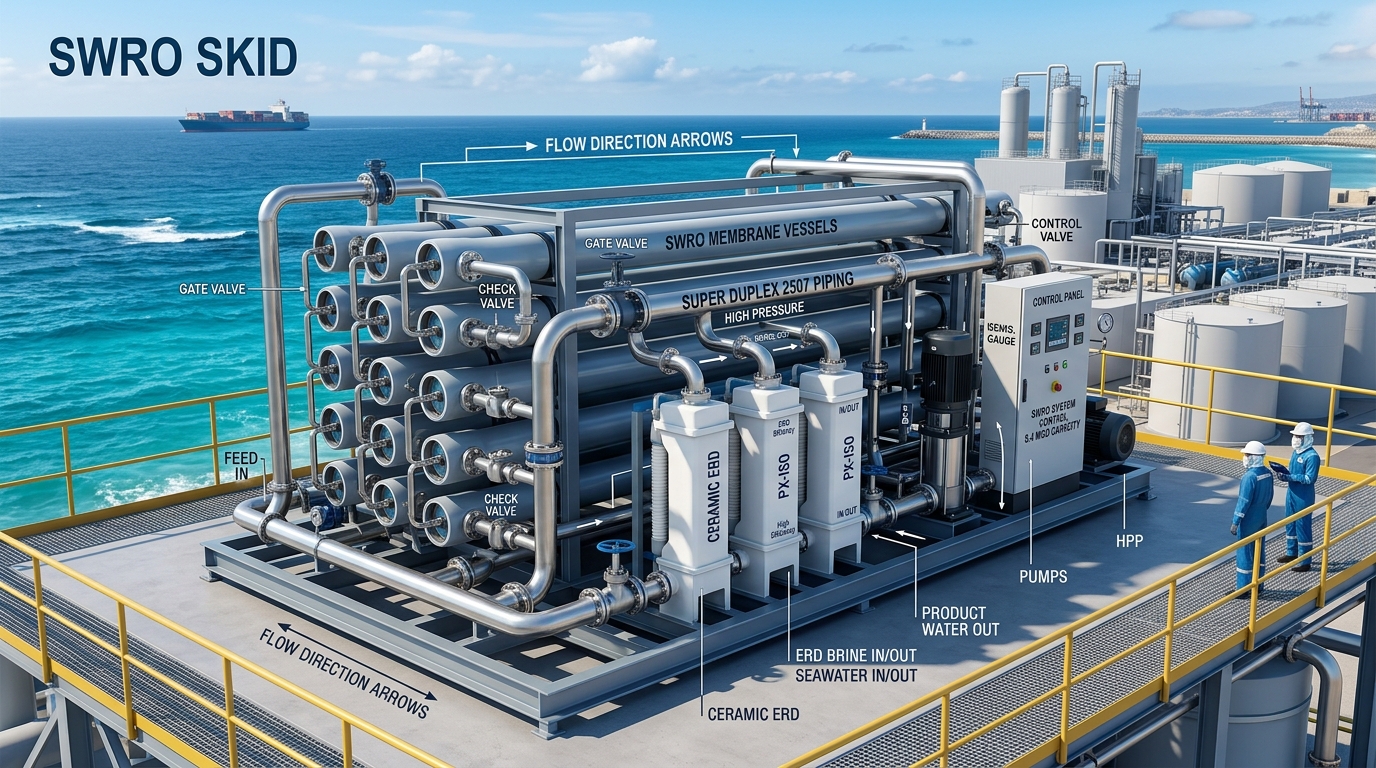
A seawater desalination plant removes dissolved salt from seawater to make fresh water for drinking, industry or boilers. Most new plants use seawater reverse osmosis (SWRO): seawater is filtered, then pushed at about 55 to 75 bar through semi-permeable membranes that let water pass and hold back around 99.8% of the salt. Typically 40 to 50% of the feed becomes fresh water; the rest leaves as concentrated brine. Energy recovery devices reuse the pressure in that brine, bringing total plant power to roughly 3 to 4 kWh per m³. In India, coastal intakes and brine outfalls need clearance under the CRZ Notification, 2019, and the brine discharge needs State Pollution Control Board consent.
- 35,000mg/L
- Typical dissolved salt (TDS) in open seawater
- 45%
- Typical fresh-water recovery of an SWRO plant
- 3 to 4kWh/m³
- Total power for a modern SWRO plant with energy recovery
- 500mg/L
- IS 10500 acceptable TDS limit for drinking water
The basics
Seawater or brackish water: which do you have?
The first question in any desalination project is how salty the source really is. Salt content is measured as total dissolved solids (TDS), in milligrams per litre (mg/L, roughly the same as ppm). Open seawater off the Indian coast is usually around 35,000 mg/L, and can reach 40,000 to 45,000 mg/L in enclosed or warm waters such as creeks and gulfs. Drinking water under IS 10500:2012 should be below 500 mg/L.
Brackish water is water that is saltier than fresh water but much less salty than the sea, typically 1,000 to 10,000 mg/L. It is what most borewells in coastal belts, saline inland aquifers in Rajasthan, Gujarat and Haryana, and tidal creeks give. Brackish water can be treated with a brackish water RO (BWRO) plant, which runs at a third of the pressure and recovers far more of the water than an SWRO plant. Choosing SWRO when brackish RO would do, or the other way round, is the most expensive mistake in this field.
Why desalination is growing in India
Coastal cities and industries can no longer count on rivers and groundwater alone. Coastal aquifers are being over-pumped and seawater is moving inland, so borewells that were fresh a decade ago now give brackish water. Chennai already runs large seawater plants, and a 400 MLD plant at Perur is being built there, the largest in the country. Worldwide there are more than 22,000 desalination plants producing roughly 100 million m³ per day.
Reverse osmosis versus thermal desalination
Reverse osmosis uses pressure and membranes. Thermal desalination boils or flashes seawater and condenses the vapour; the two main types are multi-effect distillation (MED) and multi-stage flash (MSF). Thermal plants use far more energy unless cheap waste heat is available, so almost all new plants in India, outside power stations and refineries with spare steam, are SWRO.
How it works
How does an SWRO plant work, stage by stage?
An SWRO plant is a chain. The membranes in the middle get the attention, but most failures start upstream at the intake or in pre-treatment.
| Stage | What happens | Typical equipment | Why it matters |
|---|---|---|---|
| 1. Intake | Seawater is drawn from the sea through an open intake pipe or from beach wells dug into the sand. | Intake head with screens, travelling band screens, intake pumps in non-metallic or duplex construction | Beach wells give cleaner water; open intakes give more water but need marine-life protection and shock chlorination |
| 2. Pre-treatment | Silt, algae and organic matter are removed so they do not foul the membranes. | Dissolved air flotation (DAF) for algal blooms, dual media filters (DMF) or ultrafiltration (UF) | UF gives filtrate turbidity below 0.1 NTU and a steady silt density index (SDI), even during storms and red tides |
| 3. Conditioning and cartridge filters | Chlorine is neutralised, antiscalant is dosed and the last fine particles are caught. | Sodium bisulphite and antiscalant dosing, 5 micron cartridge filters | Polyamide membranes are damaged by free chlorine; cartridges are the last guard before the pumps |
| 4. High-pressure pumping | Feed is raised to 55 to 75 bar. | Multistage or positive displacement high-pressure pumps, booster pump for the energy recovery loop | The biggest power user in the plant; needs duplex or super duplex steel wetted parts |
| 5. RO membranes | Water passes through spiral-wound polyamide thin-film membranes; salt stays behind. | Pressure vessels holding six to eight 8-inch seawater elements each | Rejects around 99.8% of salt in one pass; a second pass is added where boron or very low TDS is needed |
| 6. Energy recovery | High-pressure brine hands its pressure back to incoming seawater. | Isobaric pressure exchangers (PX), or turbochargers on smaller plants | Isobaric devices return about 96 to 98% of the brine's hydraulic energy and can cut high-pressure pumping power by up to about 60% |
| 7. Post-treatment | RO water is too pure and slightly acidic, so minerals are added back and it is disinfected. | Limestone (calcite) contactors with CO2, or lime and CO2 dosing; chlorination or UV | Without remineralisation the water corrodes pipes and tastes flat; IS 10500 also sets limits for drinking use |
| 8. Brine and waste streams | Brine, filter backwash and cleaning solutions are collected and discharged or treated. | Brine outfall with diffusers, neutralisation tank for cleaning waste | Must meet CRZ and SPCB conditions; inland plants need a reject management or ZLD plan |
Our NABL-accredited laboratory tests TDS, chloride, boron, silica, hardness, iron, turbidity and organic load across seasons, so the pre-treatment and membrane design match your real source.
Options
SWRO, brackish RO or thermal: which suits you?
The right technology depends on source salinity, how much water you need, whether you have waste heat, and what you can do with the reject.
| Feature | Brackish water RO (BWRO) | Seawater RO (SWRO) |
|---|---|---|
| Feed TDS | 2,000 to 10,000 mg/L | 35,000 to 45,000 mg/L |
| Operating pressure | 15 to 25 bar | 55 to 75 bar |
| Recovery | 75 to 85% | 40 to 50% |
| RO train energy (with energy recovery for SWRO) | 0.5 to 1.0 kWh/m³ | 2.6 to 3.2 kWh/m³; 3 to 4 kWh/m³ for the whole plant |
| High-pressure piping | SS 304/316 or high-grade PVC | Duplex 2205 or super duplex 2507 stainless steel |
| Energy recovery | Rarely needed | Essential |
| Main reject issue | Inland reject disposal; often needs ZLD | Brine outfall design and marine permits |
| Technology | Best for | Product water | Watch-outs |
|---|---|---|---|
| SWRO, single pass | Most coastal industry, resorts and towns | About 200 to 500 mg/L TDS | Boron may exceed drinking limits in warm seawater |
| SWRO with second pass | Drinking water with tight boron limits, boiler feed, pharma | Below 50 mg/L TDS; boron reduced | More power and capital; pH adjustment in the second pass |
| Brackish water RO | Saline borewells and creeks below about 10,000 mg/L | Below 500 mg/L TDS | Silica, hardness and reject disposal limit recovery |
| Containerised SWRO | Islands, remote sites, temporary or fast-track supply | As for SWRO | Fixed capacity per box; intake and outfall still need site work |
| MED (multi-effect distillation) | Power plants and refineries with low-grade waste heat | Below 25 mg/L TDS | Needs steam or hot water; large footprint; scaling at higher temperature |
| MSF (multi-stage flash) | Very large plants with abundant cheap steam | Below 25 mg/L TDS | Highest energy use; rarely chosen for new plants in India |
If your borewell TDS is below about 10,000 mg/L, you almost certainly need brackish RO, not SWRO. Test before you decide. Hardness alone, without high TDS, may only need a water softener.
Rules and standards
Which rules apply to a desalination plant in India?
A desalination plant has two compliance sides: the water it produces and the brine it discharges.
| Rule or standard | What it covers |
|---|---|
| CRZ Notification, 2019 | Siting of the plant, intake and outfall within the coastal regulation zone; clearance through the State Coastal Zone Management Authority and, for larger projects, MoEF&CC |
| Water Act, 1974 | Consent to establish and consent to operate from the SPCB for brine and waste discharge |
| Environment (Protection) Rules, 1986 | Discharge standards for marine coastal areas, including temperature and pH of discharge |
| EIA Notification, 2006 | Large desalination projects may need environmental clearance with marine impact studies |
| IS 10500:2012 | Drinking water quality: TDS 500 mg/L acceptable (2,000 mg/L permissible where no other source), boron 0.5 mg/L acceptable |
| WHO drinking water guidelines | Boron and remineralisation targets used for potable supply |
Cost
How much does a desalination plant cost in India?
Cost depends on capacity, source salinity, intake and outfall length, and how pure the product water must be. Intake and outfall works can cost as much as the RO plant itself on a difficult coast. These ranges are for early budgeting only.
| Plant | Typical use | Indicative capital cost* |
|---|---|---|
| SWRO, 10 to 50 m³/day, containerised | Island resorts, remote camps, small coastal units | ₹25 lakh to ₹1 crore |
| SWRO, 100 to 500 m³/day | Hotels, ports, coastal factories | ₹1 to ₹5 crore |
| SWRO, 1 MLD (1,000 m³/day) | Large industry, small towns | ₹8 to ₹15 crore |
| Brackish RO, 100 m³/day | Saline borewells, factories, institutions | ₹15 to ₹40 lakh |
*Indicative 2026 ranges for planning only, covering equipment, electricals and installation of pre-treatment, RO, energy recovery and post-treatment. They exclude land, buildings, marine intake and outfall works, taxes and clearance studies. We give a firm price after testing your water and surveying the site.
Running cost per cubic metre
For an SWRO plant with energy recovery, power is usually 40 to 60% of the running cost. At 3.5 kWh/m³ and an industrial tariff of about ₹8 per kWh, power alone is around ₹28 per m³. Add chemicals, membrane and cartridge replacement, labour and maintenance, and small and mid-size SWRO plants typically run at an indicative ₹40 to ₹80 per m³ before capital repayment. Very large municipal plants achieve lower figures. Brackish RO usually costs a fraction of this per m³.
What drives capital cost
- Intake type and length: beach wells vs open sea pipe
- Pre-treatment: DMF alone, or DAF plus UF
- Single or two-pass RO
- Material grade: duplex or super duplex steel
- Outfall length and diffuser design
What drives running cost
- Power, mostly high-pressure pumps
- Energy recovery efficiency
- Antiscalant, bisulphite, coagulant and cleaning chemicals
- Membrane and cartridge replacement
- Seawater temperature and salinity
Where money is usually wasted
- Design based on one grab sample
- Skimping on pre-treatment, then replacing membranes early
- No energy recovery on a small plant
- Carbon steel or SS 304 near the sea
- Permits started after the plant is ordered
We supply antiscalants, membrane cleaning chemicals and spares tested on your water, and audit energy use, recovery and cleaning frequency.
Troubleshooting
Common desalination problems, and how we fix them.
- 01The problem
Biofouling: pressure drop across the membranes rises and output falls within weeks, especially after algal blooms.
What we doAdd DAF or UF ahead of RO, switch to intermittent chlorination with full dechlorination, use non-oxidising biocides, and set a cleaning routine with alkaline cleaners.
- 02The problem
Scaling on the last elements from calcium carbonate, calcium sulphate or, in brackish water, silica.
What we doRun scaling projections from a full water analysis, select the right antiscalant and dose, and set recovery at a level the chemistry allows.
- 03The problem
Corrosion of pipes, pump casings and frames in the salt air and seawater.
What we doDuplex and super duplex steel in the high-pressure section, non-metallic (HDPE, FRP, UPVC) low-pressure lines, and coated frames.
- 04The problem
Boron in the product water is above the drinking water limit.
What we doUse high-boron-rejection elements, or add a partial second pass at raised pH, which removes boron far more effectively.
- 05The problem
Power bill far above design.
What we doCheck pump efficiency and energy recovery performance, look for fouling that raises pressure, and retrofit isobaric energy recovery where a plant runs without it.
- 06The problem
Brine discharge and coastal permits delay the project.
What we doPlan outfall design, CRZ documents and SPCB applications from day one, with environmental impact assessment support where needed.
We operate and maintain desalination and RO plants with trained operators, membrane cleaning plans, normalised performance tracking and monthly lab reports on product water.
Who uses it
Where desalination makes sense.
Desalination is worth its energy cost where fresh water is scarce, unreliable or expensive by tanker, and seawater or saline groundwater is close at hand.
Hotels and island resorts
Containerised SWRO for drinking, kitchens, pools and laundry where groundwater is saline or protected.
Hotel guide →Power plants and refineries
Boiler feed and process water, often with a second RO pass or MED using waste heat.
All industries →Coastal chemical and pharma units
Process and utility water from seawater or saline borewells, with reject handled within consent.
Pharma guide →Ports and shipyards
Water for vessels, wash-down and staff where the municipal supply does not reach.
EPC projects →Coastal towns and utilities
Municipal SWRO with remineralisation to IS 10500 and brine outfalls under CRZ clearance.
EPC projects →Saline borewells
Brackish RO for factories and institutions in Rajasthan, Gujarat and other saline belts, with reject recovery.
Reject management →Buying guide
What to ask before you buy a desalination plant.
Use this list with any supplier, including us.
- Was the design based on seasonal water tests? Salinity, temperature, turbidity and algae change through the year and after monsoon.
- What is the guaranteed product quality and recovery? In writing, at the worst-case feed salinity and temperature.
- What is the specific energy in kWh/m³? For the whole plant, including intake and pre-treatment, not only the RO train.
- Which energy recovery device is offered? Isobaric, turbocharger or none, and its stated efficiency.
- What materials are used in the high-pressure section? Duplex or super duplex for seawater.
- How is brine disposed of, and who handles CRZ and SPCB permits?
- What is the membrane warranty and expected replacement rate? And which projection software was used.
- Who runs it after commissioning? Operator training, cleaning plans, chemical supply and an O&M contract.
Why Rispri
One team from water sample to running plant.
Our own NABL lab
We test your source water through the seasons before design and verify product water after start-up.
Engineering since 1999
1,498+ plants and turnkey projects, from compact STPs for hotels to industrial ETP, RO and ZLD systems.
Compliance planned in
CRZ, SPCB and drinking water requirements are part of the design from the first drawing.
We stay after handover
Antiscalants, cleaning chemicals, spares, operator training and O&M contracts keep the plant running.
Questions
Seawater desalination FAQs.
What is a seawater desalination plant?
A seawater desalination plant removes dissolved salts from seawater to produce fresh water. Most modern plants use seawater reverse osmosis (SWRO), which pushes filtered seawater through membranes at high pressure, leaving the salt behind in a brine stream.
What is the difference between SWRO and brackish water RO?
SWRO treats seawater at around 35,000 mg/L TDS and runs at 55 to 75 bar with about 40 to 50% recovery. Brackish water RO treats water of roughly 1,000 to 10,000 mg/L, runs at 15 to 25 bar and recovers 75 to 85%, so it uses far less energy per cubic metre.
How much does a desalination plant cost in India?
As an indication, a containerised SWRO plant of 10 to 50 m³/day costs about ₹25 lakh to ₹1 crore, and a 1 MLD plant about ₹8 to ₹15 crore, excluding land, marine works and taxes. Intake and outfall works can add a lot on difficult coasts, so we price after a site survey and water test.
What is the cost of desalinated water per cubic metre?
For small and mid-size SWRO plants, running cost is typically in the region of ₹40 to ₹80 per m³ before capital repayment, with power the largest share. Large municipal plants achieve lower costs, and brackish RO is much cheaper per cubic metre.
How much electricity does SWRO use?
A modern SWRO train with isobaric energy recovery uses about 2.6 to 3.2 kWh per m³, and the whole plant including intake and pre-treatment about 3 to 4 kWh per m³. Without energy recovery, consumption is much higher.
What does an energy recovery device do?
The brine leaving the membranes is still at high pressure. An isobaric pressure exchanger passes that pressure directly to incoming seawater, returning about 96 to 98% of the brine's hydraulic energy and cutting high-pressure pump power by up to about 60%.
What is the recovery rate of a seawater RO plant?
Most SWRO plants recover 40 to 50% of the feed as fresh water. Higher recovery raises the brine's salinity and the pressure needed, and increases scaling risk, so 45% is a common design point.
How is brine from a desalination plant disposed of?
Coastal plants return brine to the sea through an outfall pipe with diffusers that mix it quickly with seawater, under CRZ clearance and SPCB consent. Inland brackish RO plants usually need reject recovery or zero liquid discharge because there is no sea to discharge to.
Is desalinated water safe to drink?
Yes, once it is remineralised and disinfected. RO water is very low in minerals and slightly acidic, so calcium and alkalinity are added back, and boron is checked against IS 10500 and WHO guidance. We test product water in our NABL-accredited laboratory.
How long do SWRO membranes last?
With good pre-treatment and correct chemical dosing, seawater polyamide membranes typically last 3 to 5 years before replacement. Poor pre-treatment, chlorine exposure or hard scaling can shorten that sharply.
Can a containerised SWRO plant be installed at an island resort?
Yes. Self-contained 20 ft and 40 ft containerised units hold pre-treatment, high-pressure pumps, energy recovery and remineralisation, so site work is limited to the intake, outfall, power and storage. They suit islands and remote sites where speed matters.
Do I need SWRO for my saline borewell?
Usually not. Most saline borewells are brackish, below about 10,000 mg/L TDS, and brackish water RO treats them at much lower cost. A lab test of TDS, hardness and silica tells you which plant you need.
Do you operate and maintain desalination plants?
Yes. We run desalination and RO plants under O&M contracts with trained operators, supply antiscalants, cleaning chemicals and spares, and provide monthly lab reports on product water.
Related