INDUSTRIES / LEATHER AND TANNERIES
Tannery effluent treatment
that recovers chrome and controls salt.
Tannery wastewater carries three problems at once: salt from cured hides, sulphide from liming and chromium from tanning. We test each stream in our NABL-accredited laboratory, separate them at source, recover the chrome and design the ETP, RO and evaporator around what is left.
In short
How tannery wastewater is treated.
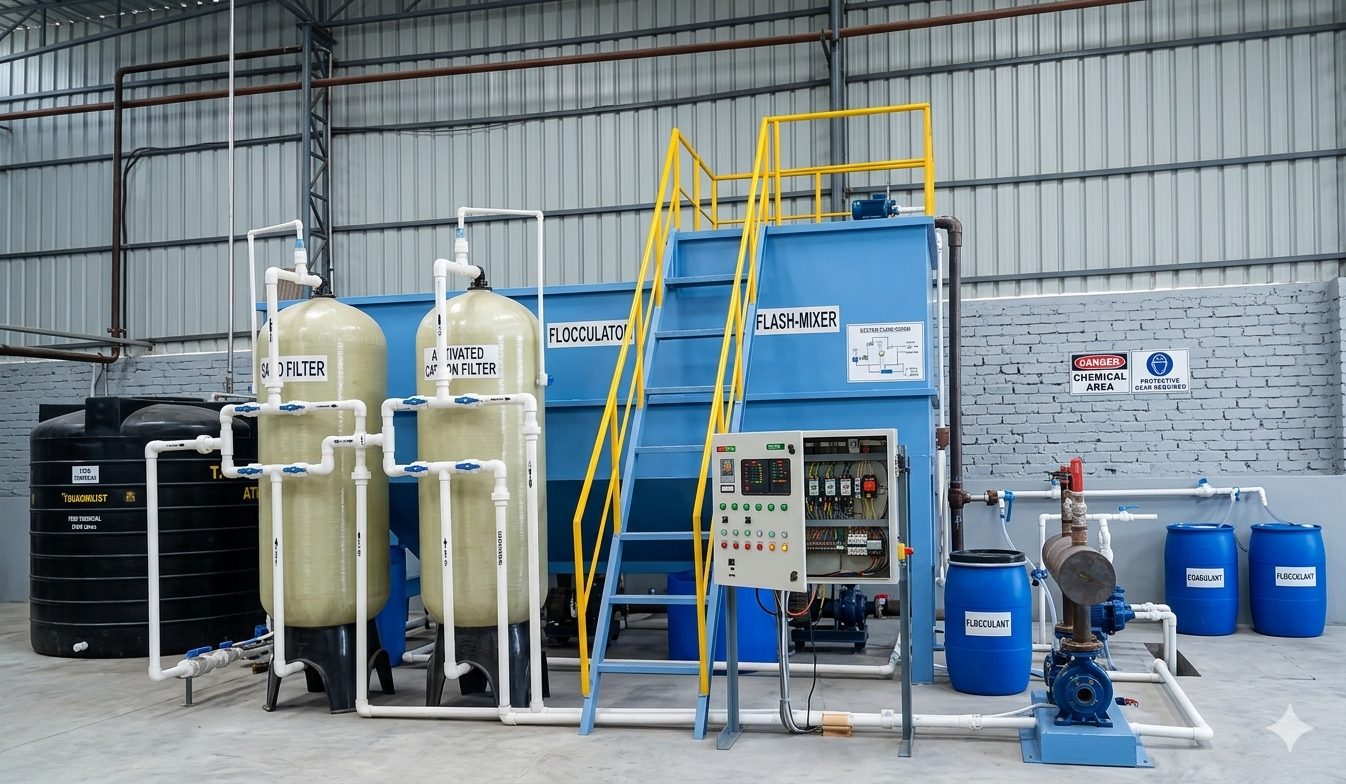
A tannery effluent treatment plant cleans the wastewater from soaking, liming, deliming, pickling, chrome tanning, retanning, dyeing and fatliquoring. The key is segregation: salty soak liquor, sulphide-rich lime liquor and chrome liquor are kept apart. Chrome liquor goes to a chrome recovery unit, where chromium is precipitated and redissolved for reuse; lime liquor is oxidised to remove sulphide. The combined flow then passes through equalisation, chemical treatment, biological treatment and tertiary filters, and, where zero liquid discharge is required, RO and an evaporator.
Tanneries are one of CPCB's 17 categories of highly polluting industries and must meet the tannery standards under the Environment (Protection) Rules, 1986, including limits for total and hexavalent chromium.
- 2.0mg/L
- Total chromium limit for discharge to inland surface water
- 0.1mg/L
- Hexavalent chromium limit for discharge to inland surface water
- 2.0mg/L
- Sulphide limit for discharge to inland surface water
- 17categories
- CPCB's list of highly polluting industries, which includes tanneries
Where it comes from
Where does tannery effluent come from?
Leather making turns a raw or salted hide into a stable material in a long chain of wet steps, almost all of them carried out in drums or pits full of water. The work is usually split into the beamhouse (preparing the hide), the tanyard (tanning) and post-tanning (retanning, dyeing and fatliquoring). Each step leaves a very different liquor behind.
| Process | What it does | What it adds to the effluent |
|---|---|---|
| Soaking | Rehydrates salt-cured hides and washes off dirt, dung and blood | Very high salt (chlorides and TDS), suspended solids, proteins and BOD |
| Liming and unhairing | Lime and sodium sulphide loosen and dissolve hair and open up the fibre | Sulphide, high pH (around 12), dissolved hair and protein, very high COD and solids |
| Fleshing | Removes fat and flesh from the inner side of the hide | Fat, flesh and lime; mostly solid waste with some wash water |
| Deliming and bating | Ammonium salts and enzymes lower the pH and clean the grain | Ammonia and nitrogen, residual sulphide, protein |
| Pickling | Salt and acid prepare the pelt to take up chrome | Salt, acidity |
| Chrome tanning | Basic chromium sulphate cross-links the collagen to make wet-blue leather | Trivalent chromium (only part of the chrome is taken up), salt, sulphate, low pH |
| Sammying and splitting | Presses water out of wet-blue and splits it to thickness | Small volumes of chrome-bearing water; chrome shavings as solid waste |
| Retanning, dyeing and fatliquoring | Gives the leather its final feel, colour and softness | Vegetable and synthetic tannins, dyes, oils, some chromium, COD |
| Washing between steps | Rinses the hides after each operation | A large share of the volume, carrying a little of every chemical above |
Typical effluent characteristics
| Parameter | Typical range | Why it matters |
|---|---|---|
| pH | 7 to 10 composite; about 12 in lime liquor and 3 to 4 in chrome liquor | Mixing acid chrome liquor with sulphide-rich lime liquor can release toxic hydrogen sulphide gas |
| COD | 3,000 to 8,000 mg/L | Protein, fat and tannins; the beamhouse contributes most of it |
| BOD | 1,000 to 3,000 mg/L | Biodegradable, but only after sulphide and chromium are brought down |
| TDS | 8,000 to 20,000 mg/L, mostly chloride and sulphate | Salt is not removed by biology; it is why tannery ZLD needs RO and evaporation |
| Chlorides | 3,000 to 10,000 mg/L | Comes mainly from salt-cured hides and pickling |
| Sulphide | 50 to 300 mg/L composite; far higher in lime liquor | Toxic, corrosive and smelly; kills bacteria and attacks concrete |
| Total chromium | 50 to 200 mg/L without chrome recovery | Strict discharge limits; makes the sludge hazardous |
| Suspended solids | 1,500 to 5,000 mg/L | Hair, lime, flesh and fibre that block pumps and fill tanks |
| Total Kjeldahl nitrogen | 200 to 600 mg/L | From protein and deliming salts; can need nitrification and denitrification |
| Oil and grease | 100 to 500 mg/L | From natural hide fat and fatliquors; forms scum |
The biggest design decision is made upstream of the ETP. When soak, lime and chrome liquors share one drain, the plant must fight salt, sulphide and chromium together. Collecting them separately is cheaper than any treatment step that follows.
Standards and rules
Which standards apply to tannery effluent?
The Environment (Protection) Rules, 1986 contain industry-specific standards for tanneries, and the general standards in Schedule VI apply to any parameter the tannery standard does not cover. The values below are the key limits for discharge to inland surface water; your consent to operate may be stricter, set limits for chlorides and TDS, or require zero liquid discharge.
| Parameter | Limit, inland surface water |
|---|---|
| Total suspended solids | 100 |
| BOD (3 days at 27 °C) | 30 |
| COD | 250 |
| Total chromium | 2.0 |
| Hexavalent chromium | 0.1 |
| Sulphide | 2.0 |
| Oil and grease | 10 |
| Chlorides and TDS | Set in the tannery standard and your consent; many boards now require ZLD instead |
Treatment scheme
A tannery ETP and ZLD, stage by stage.
This is the scheme we start from for a chrome tannery working from raw or salted hides. Stages 1 to 3 happen at the stream level, before the liquors meet; stages 4 to 7 are the ETP; stages 8 and 9 are added for ZLD.
| Stage | What happens | Typical units |
|---|---|---|
| 1. Segregate soak liquor | The salty first soak is collected on its own. It holds much of the tannery's salt in a small part of the flow. | Separate drain and tank; screening; settling; solar evaporation pan or a dedicated evaporator where allowed |
| 2. Oxidise lime liquor | Sulphide in the lime and unhairing liquor is oxidised to harmless sulphate while the liquor is still alkaline, so no hydrogen sulphide escapes. | Aerated tank with manganese sulphate catalyst, or hydrogen peroxide dosing; hair screen |
| 3. Recover chrome | Spent chrome liquor is screened, then chromium is precipitated as chromium hydroxide with an alkali, filtered and redissolved in sulphuric acid for reuse in tanning. | Collection tank, precipitation reactor, filter press, redissolution tank |
| 4. Screen and equalise | All remaining streams are screened for hair, flesh and fibre and mixed so that strength and pH even out. | Bar and fine screens, grit and fat trap, equalisation tank with mixing |
| 5. Chemical treatment | Coagulants and polyelectrolyte settle out solids, residual chromium and part of the COD. | Flash mixer, flocculator, primary clarifier; lime, alum or ferric, polymer |
| 6. Biological treatment | Bacteria remove BOD, COD and nitrogen. Salt-tolerant cultures and long sludge age are needed. | Extended aeration or SBR, sometimes with an anoxic tank for nitrogen; secondary clarifier |
| 7. Tertiary polish | Final solids, colour and COD are removed to meet the outlet limits or protect the RO. | Pressure sand filter, activated carbon filter, ultrafiltration |
| 8. Reverse osmosis | Recovers low-salt water for the beamhouse and washing; concentrates the salt into a reject. | Two or three stage RO, sometimes high-pressure RO on the reject |
| 9. Evaporate | The reject is evaporated; condensate is reused and the salt is dried and stored or disposed of as directed. | MEE or MVR, non-thermal RCD vaporiser, agitated thin-film dryer |
Options compared
| Option | Best for | Watch-outs |
|---|---|---|
| Catalytic air oxidation of sulphide | Lime liquor at high pH; low running cost | Needs enough air and contact time; pH must stay high |
| Chrome recovery by precipitation | Any tannery with a separate chrome liquor drain | Recovered liquor must be checked for iron, fat and protein before reuse |
| Extended aeration or SBR | Combined effluent after sulphide and chrome are removed | Salt slows the biology; needs acclimatised sludge and steady salinity |
| Anaerobic treatment (UASB) | High-BOD streams in large plants and CETPs | Sulphate is reduced back to sulphide; biogas carries hydrogen sulphide and needs scrubbing |
| RO with evaporation | ZLD and water recovery | Scaling and fouling from organics and calcium; reject handling cost |
Our NABL-accredited laboratory tests soak, lime, chrome and composite samples for COD, BOD, TDS, chlorides, sulphide, total and hexavalent chromium, and nitrogen, and runs jar tests on precipitation and coagulation.
Chrome recovery, reuse and ZLD
Leather industry ZLD starts with the chrome drain.
Zero liquid discharge (ZLD) for a tannery means recovering the water through RO and turning the salty reject into solids, so that no effluent leaves the site. Before that step, two recoveries make the whole plant cheaper and safer.
Chrome recovery from tannery wastewater
In conventional chrome tanning only part of the basic chromium sulphate fixes to the leather; the rest stays in the spent liquor. Chrome recovery collects that liquor separately, raises the pH with an alkali such as magnesium oxide, lime or caustic soda so that chromium settles as chromium hydroxide, presses the cake and dissolves it again in sulphuric acid. The result is a chrome liquor that can replace part of the fresh tanning salt. It also keeps most of the chromium out of the ETP, so the ETP sludge carries far less of it.
Direct reuse of floats
Lime and pickle floats can often be reused for a further batch after screening and topping up, and chrome floats can be recycled directly into the next pickle-tan cycle. These process changes reduce both chemical use and the load on the ETP.
Salt and the soak liquor
Soak liquor is a small, very salty stream. Keeping it out of the main ETP protects the biology and lowers the TDS that the RO has to fight. It can be evaporated on its own, in solar pans where the board allows or in an evaporator.
Evaporation without the steam bill
The evaporator is the costliest step of tannery ZLD. Our non-thermal RCD vaporiser evaporates RO reject with air on rotating disks, at about ₹80 to 160 per cubic metre against ₹430 to 1,070 in a steam MEE. Forward osmosis RO reject recovery can pull more water out of the reject first.
Cost
How much does a tannery effluent treatment plant cost?
For tanneries, the cost depends on hides processed per day, whether you start from raw hides or wet-blue, how well the streams are segregated, and whether ZLD is required. Use these ranges to budget.
| Plant | Typical scope | Indicative cost* |
|---|---|---|
| Chrome recovery unit, 5 to 20 KLD of chrome liquor | Collection, precipitation, filter press, redissolution | ₹15 to 50 lakh |
| Pre-treatment for a CETP member, 50 to 100 KLD | Screening, sulphide oxidation, chrome recovery, primary treatment | ₹30 to 80 lakh |
| Full ETP, 200 to 300 KLD | Segregation, chemical and biological treatment, tertiary filters | ₹1.5 to 3.5 crore |
| ZLD, 200 to 300 KLD | ETP plus UF, RO, evaporator and dryer | ₹5 to 12 crore |
*Indicative 2026 ranges for equipment, electricals and installation, excluding land, civil works and taxes. Salt load, chromium load, the evaporator chosen and the degree of segregation change the figure a lot, so we price only after testing. Running costs are typically ₹40 to 90 per m³ for the ETP, ₹50 to 100 per m³ for UF and RO, and ₹430 to 1,070 per m³ evaporated in a steam MEE.
What drives capital cost
- Hides per day and raw-to-finish or partial process
- Salt load from cured hides
- Segregated drains or one mixed drain
- Discharge, CETP connection or full ZLD
- Evaporator and dryer type
What drives running cost
- Steam or power for evaporation
- Coagulants, polymer and sulphide chemicals
- Hazardous sludge and salt disposal
- RO cleaning and membrane life
- Aeration power
Where tanneries save money
- Chrome recovered instead of bought
- Soak liquor kept out of the main plant
- Lime and pickle floats reused
- Less chromium in sludge, so less hazardous mass
- RO permeate replacing bought water
We test your reject, trial it on our non-thermal evaporator module and pilot it beside your existing evaporator, so you see the saving on your own stream first.
Troubleshooting
Common tannery ETP problems, and how we fix them.
- 01The problem
Strong rotten-egg smell in the equalisation tank and corrosion of concrete and steel.
What we doSeparate the lime liquor, oxidise sulphide while the pH is still high, keep acid chrome liquor out of the same drain, and add gas detection where people work.
- 02The problem
Outlet chromium is above the limit.
What we doRoute all chrome floats and sammying water to chrome recovery, correct the precipitation pH and add a polishing step for residual metal.
- 03The problem
The aeration tank stops working after salty or high-sulphide batches.
What we doHold soak liquor out of the biology, enlarge equalisation, and build up a salt-tolerant sludge with steady feed and nutrient dosing.
- 04The problem
RO membranes scale and foul within days.
What we doImprove biological and tertiary treatment, add UF, soften where calcium is high, and supply antiscalants and cleaning chemicals tested on your feed.
- 05The problem
Sludge volume and disposal cost keep rising.
What we doRecover chrome upstream so less chromium reaches the sludge, optimise coagulant dose and dewater with a filter press.
What we offer
What Rispri does for tanneries.
Effluent and sludge testing
Chromium (total and hexavalent), sulphide, chlorides, COD and sludge classification in our NABL-accredited lab.
Testing services →Tannery ETP
Segregation, sulphide oxidation, chemical and biological treatment and tertiary filters, designed and built.
Effluent treatment plants →Chrome and metal recovery
Capture chromium from tanning liquors and residual metal from treated water.
Heavy metal recovery →Leather industry ZLD
UF, RO, evaporators and dryers for tanneries that may not discharge.
ZLD plants →Non-thermal evaporator
RCD vaporisers that evaporate RO reject and salty streams with air instead of steam.
Non-thermal evaporators →Treatment chemicals
Coagulants, polymers, antiscalants and RO cleaners matched to tannery effluent.
Water treatment chemicals →Buying guide
What to ask before you buy a tannery ETP.
Use these questions with any supplier, including us.
- Were soak, lime and chrome liquors tested separately? A composite sample hides the real design loads.
- How is sulphide handled, and where? Ask for the oxidation method and how hydrogen sulphide release is prevented.
- Is chrome recovery included, and what quality is the recovered liquor? It should be fit to reuse in tanning.
- Which outlet values are guaranteed? Total and hexavalent chromium, COD, sulphide and TDS, against my consent or CETP inlet norms.
- How will the biology cope with salt? Start-up plan, sludge acclimatisation and the TDS it is designed for.
- What does ZLD cost to run per m³? Steam or power, chemicals, membranes and salt disposal.
- How is sludge classified and disposed of? Volume per day, dewatering and TSDF cost.
- Who runs it after commissioning? Training, O&M and monthly NABL test reports.
Why Rispri
From the drum outlet to reused water, one team.
Our own NABL lab
We test each liquor before design and certify chromium and sulphide at the outlet after start-up.
Engineering since 1999
1,498+ plants and turnkey projects for 499+ clients across industry, hotels, hospitals and cities.
Research partnerships
Metal recovery, RO reject recovery and non-thermal evaporation, delivered in collaboration with IIT Bombay, IIT Kharagpur and ICT Mumbai.
Chemicals and O&M in house
Coagulants, RO chemicals, spares and trained operators from offices in Jaipur, Agra and Ahmedabad.
Questions
Tannery effluent treatment FAQs.
What is a tannery effluent treatment plant?
A tannery ETP treats wastewater from soaking, liming, tanning, retanning and dyeing so that it meets the tannery standards, a CETP's inlet norms or a ZLD condition. It usually combines stream segregation, sulphide oxidation, chrome recovery, chemical and biological treatment and tertiary filtration.
How is chrome recovered from tannery wastewater?
Spent chrome liquor is collected separately and an alkali such as magnesium oxide, lime or caustic soda is added so that chromium settles as chromium hydroxide. The cake is filtered and dissolved in sulphuric acid to make chrome liquor that can be reused in tanning.
Why must lime liquor and chrome liquor be kept apart?
Lime liquor is alkaline and full of sulphide; chrome liquor is acidic. When they mix, the pH falls and the sulphide turns into hydrogen sulphide gas, which is toxic and has killed workers in drains and tanks. Mixing also makes chrome recovery impossible.
How is sulphide removed from tannery effluent?
The usual method is catalytic air oxidation: the lime liquor is aerated at high pH with a manganese salt as catalyst, turning sulphide into sulphate. Hydrogen peroxide or iron salts are used for smaller volumes or as a polish.
What are the discharge limits for chromium from tanneries?
For discharge to inland surface water, total chromium is limited to 2.0 mg/L and hexavalent chromium to 0.1 mg/L. Many tanneries discharge to a CETP or must achieve ZLD instead, so check your consent.
Is ZLD mandatory for tanneries?
It depends on your state and consent. Tanneries and tannery CETPs in Tamil Nadu have been required to move to zero liquid discharge, and other boards set ZLD or strict TDS limits as consent conditions. Check your consent to operate.
Is tannery sludge hazardous waste?
Yes. Chromium-bearing residues and sludge from tanneries are listed as hazardous waste under the Hazardous and Other Wastes Rules, 2016, and must be stored, transported and disposed of through an authorised TSDF.
Do tanneries need online monitoring (OCEMS)?
Tanneries are among CPCB's 17 categories of highly polluting industries, which are generally required to install online continuous effluent monitoring linked to CPCB and SPCB servers. The parameters are set in your consent.
How much does a tannery ETP cost?
As an indication, a chrome recovery unit costs about ₹15 to 50 lakh, a 200 to 300 KLD tannery ETP about ₹1.5 to 3.5 crore, and ZLD for the same flow about ₹5 to 12 crore, excluding land and civil works. We price after testing your liquors.
Can a small tannery connect to a CETP instead?
Yes, where a CETP serves the cluster and the board allows it. The tannery must usually screen its effluent, recover chrome and meet the CETP's inlet norms for pH, solids, sulphide and chromium before sending it.
Related